Fast Fitness - Eighth Group Functional Training: Spine and Shoulder Stability With Overhead Motions
Friday, April 23, 2010
Jolie Bookspan, M.Ed, PhD, FAWM
Here is Fast Friday Fitness - eighth in the series of Functional Fitness Training (Bookspan Basics) to teach your group, teams, classes, students, kids, battalions, or self. In this Bookspan Basic Training, you train positioning and muscle skills to reach overhead with healthy mechanics for the shoulder and lower back.
Assemble your group in neat rows. Stand in front in view of all. Tell them this is a basic, functional physical skill to learn to prevent injurious positioning during overhead motions.
Everyone reaches up. Have everyone notice if they lean their upper body backward to raise their arms. See if their tilt their beltline downward in front or push the hip/pelvis forward. See examples in both photos above and below. Explain that leaning back and increasing the lower spine arch are not a healthy ways to raise arms and that upright neutral spine is a stronger base for their arm movement and uses abdominal muscles.
Have everyone bring their ribs back down to level, pull upper body to upright, and tuck the hip under to straighten the pelvis to vertical and neutral. The motion is like doing an abdominal crunch standing up, without curling forward. You crunch enough to bring yourself to straight and upright. See our short movie of fixing this on Overhead Lifting, Reaching, and Throwing Part II - Lower Back.
Have everyone hold their upper body upright and vertical and notice where their shoulder is and try it again with healthy position.
Leaning back when raising arms increases the inward curve of the lower back, causing a swayback, hyper-lordotic posture. Hyperlordosis is a common source of "mystery" back pain. It comes when you over-arch - usually during long standing, walking, running, reaching, then goes away. People are mystified. Look at both photos again. It is easily prevented by stopping the injurious position then and there. Send your success photos to me at DrBookspan.com.
Make sure everyone breathes. A bad habit promoted by much popular fitness is tightening the abdominal and backside muscles to do minor movements. People hold their breath. Make sure all can do full relaxed belly breathing while holding neutral spine and reaching both arms overhead. Remind all to keep their shoulders down and not raise the shoulders when they raise the arms.
I was honored to learn that for my work in world health, I have been awarded The Humanitarian Award.
It will be presented this November in Pittsburgh.
As a vegetarian, I have often heard the joke, "If a vegetarian eats vegetables, what does a humanitarian eat?" I will now be able to officially find out and let you know.
Fast Fitness - Seventh Group Functional Training: Advancing Ankle and Knee Safety With Single Leg Jumps
Friday, April 16, 2010
Jolie Bookspan, M.Ed, PhD, FAWM
Here is Fast Friday Fitness - seventh in the series of Functional Fitness Training (Bookspan Basics) to teach your group, teams, classes, students, kids, battalions, or self. In this Bookspan Basic Training, you advance lower leg stability from single leg vertical jumps to lateral movement:
Assemble your group in neat rows. Stand in front in view of all. Tell them this is a basic, functional physical skill to learn how to reduce lower body injuries during sideways jumps. Remind them they need to use the same principles from the Third, Fifth, and Sixth FFT of vertical jumps.
Have everyone crouch using good bending (knees do not sway inward or slide forward, taught in the first skill), then rise to toes with stable neutral ankle (not bowing outward at the side, taught in the second skill). Remind them that when they land from a jump they use the same neutral ankle.
Stand with good stance on one leg only. Have them leap side to side from one leg to the other
Then try it jumping side to side on the same leg. Switch and repeat.
Use this for improving ability and reducing injury potential from changing direction, cutting, lateral movement, landing to the side from jumps, slips and missteps, and more. It builds on the Third, Fifth, and Sixth Functional Training exercises where you learned to jump vertically (up and down), laterally (side to side) with good lower body mechanics, then advanced to vertical single leg jumps.
During actual real life walking around, practice this by hopping (from one foot to the same one foot only) from point to point. Use street cracks and lines as goal points.
Trainers, Drill Instructors, readers, send in your stories of how you use these in your program.
Good body mechanics are a powerful performance enhancing aid.
Fast Fitness - Sixth Group Functional Training: Advancing Ankle and Knee Safety With Single Leg Movement
Friday, February 26, 2010
Jolie Bookspan, M.Ed, PhD, FAWM
Here is Fast Friday Fitness - sixth in the series of FunctionalFitness Training (Bookspan Basics) to teach your group, teams, classes, students, kids, battalions, or self.
Today, Feb 26th, is my birthday. Celebrate with healthy movement and having some fun. In this Bookspan Basic Training, advance your lower leg stability with single leg use, to be ready for landing from jumps, slips and missteps, and more.
It builds on the Third and Fifth Functional Training exercises where you learned to jump vertically (up and down) and leap laterally to one foot (side to side) with good lower body mechanics.
Assemble your group in neat rows. Stand in front in view of all. Tell them this is a basic, functional physical skill to learn how to reduce knee and ankle injuries during sideways jumps. Remind them they need to use the same principles from previous (Third) Basic Training of vertical jumps:
Have everyone bend both knees to crouch using good bending (knees do not sway inward or slide forward, taught in the first skill), then rise to toes with stable neutral ankle (not bowing outward at the side, taught in the second skill).
Have them stand on one leg only. Repeat crouching then rising to the ball of that foot (half-toe) on that one leg. Rise and lower on one leg. Don't let body weight sway outward to the small toes, turning the ankle. Keep strong neutral stance. Repeat 10-100 times, depending on time and need.
Remind them that when they land from a jump, they use the same good bending and neutral ankle. Then use all good mechanics to hop - jump and land on that one leg. Hop 10-100 times, depending on time and need. Change legs and repeat.
Photo - lower limb stability and placement during landings of all kinds prevents injuries. Practice so you don't turn your ankle or knee.
Each new Functional Training exercise shows how to teach your groups (or self) how to prevent common musculoskeletal problems during the team season or operational theater.
Trainers, Drill Instructors, readers, send in your stories of how you use these in your program.
Good body mechanics are a powerful performance enhancing aid.
--- Read success stories and send your own. See if your answers are already here - click Fitness Fixer labels, links, archives, andIndex. Subscribe free - updates via e-mail or RSS, upper right. For personal medical questions - Replies to Medical Questions. Limited Class space for personal feedback. Top students may earn certification throughDrBookspan.com/Academy. Learn more in Dr. Bookspan's Books.
Fast Fitness - Fourth Group Functional Training Exercise, Functional Upper Back Stretch
Friday, November 13, 2009
Jolie Bookspan, M.Ed, PhD, FAWM
Here is Fast Friday Fitness from the 2009 Black Belt Hall of Fame. I am here teaching and learning.
In my "Stretching Smarter" workshop here, I teach healthier ways to move and stretch for daily life and sports. One is the fourth Functional Fitness Training (Bookspan Basics). It retrains how you look and reach upward, to reduce neck and shoulder compression and give a built-in stretch for the upper back:
Assemble your group (or yourself) and tell them that when they look upward, to feel the range of motion more from their upper back than neck. Have them feel, notice, and visualize where is their upper back - one way to do this is to watch a person in line ahead of them.
Remind the group that the neck is not a Pez dispenser - the idea is not to pinch the neck back (photo below with yellow hat), but to "unround" and lift upward more from the upper body.
photo shows unhealthful neck compression - pinching back and jutting chin, creating a postural spondylolisthesis.
3. Have everyone look upward by straightening the upper back and by lifting more in the chest (drawing, upper bike rider on water bottle). Repeat while reaching upward with both hands. Make sure not to return to pinching backward at the neck, jutting the chin forward (photo above), or leaning the upper body backward. Get the reach from the shoulders.
Use conscious control to prevent pinching your neck back every time you look and reach upward.
Each new Functional Training (or Bookspan Basic) shows how to teach your groups (or self) how to prevent common musculoskeletal problems during the team season or operational theater. Trainers, Drill Instructors, readers, send in your stories of how you use these in your program.
Good body mechanics are a powerful performance enhancing aid.
Read success stories of these methods and send your own. Before asking questions, see if your answers are already here by clicking labels under posts, links in posts, archives at right, and The Fitness Fixer Index. Subscribe to The Fitness Fixer, free. Click "updates via e-mail"(under trumpet) upper right. For personal medical questions - Replies to Medical Questions. Limited Class spaces for personal feedback. Top students may apply for certification through DrBookspan.com/Academy. Learn more in Dr. Bookspan's Books.
Fast Fitness - Third Group Functional Training Exercise: Ankles and Knees in Jumps and Landings
Friday, October 02, 2009
Jolie Bookspan, M.Ed, PhD, FAWM
Here is Fast Friday Fitness - third in the series of Functional Fitness Training (Bookspan Basics) to teach your teams, squads, classes, students, kids, groups, battalions, etc.
Assemble your group in neat rows. Stand in front in view of all. Tell them this is a basic, functional physical skill to reduce musculoskeletal injuries, that puts together the first and second skills, previously learned:
Tell everyone to crouch using good bending (knees do not sway inward or slide forward, taught in the first skill), then rise to toes with stable neutral ankle (not bowing outward at the side, taught in the second skill).
Next, have everyone bend and rise increasingly rapidly and smoothly, in a jumping motion, first without rising from the ground, then barely jumping. With each bend and rise, they maintain good knee bending and neutral ankle. Repeat 10-100 times, depending on time and needs.
Next, tell everyone to jump, landing softly using thigh and hip muscles for shock absorption, and good knee bending and neutral ankle. Start jumping moderately, then work for increasing height with each repetition. Repeat 10-100 times, depending on time and needs.
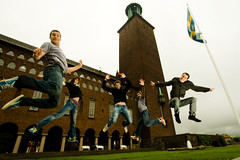
Use conscious control to prevent inversion sprains and turns by not allowing the ankle to invert (turn sideways) when rising to toe during push-off in running and jumping, and coming down during landings. Watch for healthy ankle and knee stability and placement throughout the team season.
Each new Functional Training exercise shows how to teach your groups (or self) how to prevent common musculoskeletal problems during the team season or operational theater. Learn this one to be ready for an upcoming FFT, needed for cutting, changing direction, lateral movement, more.
Trainers, Drill Instructors, readers, send in your stories of how you use these in your program.
Good body mechanics are a powerful performance enhancing aid.
--- Read and contribute your own success stories of these methods. Before asking questions, see if your answers are already here - click labels under posts, links in posts, archives at right, and the Fitness Fixer Index. For answers to personal medical questions - Replies to Medical Questions. Subscribe to The Fitness Fixer, free. Click "updates via e-mail"(under trumpet) upper right. See Dr. Bookspan's Books, take a Class, get certifiedDrBookspan.com/Academy.
Fast Fitness - Second Group Functional Training Exercise: Ankle Stability and Ability
Friday, September 25, 2009
Jolie Bookspan, M.Ed, PhD, FAWM
Here is Fast Friday Fitness - the second of the promised series of Functional Fitness Training (call it FFT or Bookspan Basics until we create a better name) that you can teach your teams, squads, classes, students, kids, groups, battalions, etc.
Assemble your group in neat rows. Footwear is whatever used for their sport or activity. Stand in front facing forward. Everyone sees your feet and you see each participant's feet. Tell them this Functional Fitness Training exercise is a basic, needed many dozens of times every day, for their sport or activity, and for daily life - ankle stability when rising to toes, stepping down, landing from jumps, running, turning skills, and other motions requiring ankle stability:
Tell everyone to stand straight and lift heels to stand on the ball of the feet
Tell everyone to look down at their own feet. Weight should not shift outward/sideways over the small toes. While everyone holds tip-toe, make sure each participant straightens ankles, shifting weight back over the big and second toe. Prevent teetering and turning outward.
Have everyone stand flat again, then rise to toes again, this time properly without needing to adjust ankles. They should feel the difference - using leg and ankle muscles instead of letting body weight slide sideways, which bends ankles into classic sprain position - turned at the outside (inversion).
Repeat good toe-rising 10 times or any number that suits your group's need - more for groups needing higher training (or groups with poorer memory), faster for teams requiring this skill done quickly in actual use, and so on. Tell everyone they will need this for skill #3 - for stepping down and landing from jumps. This is scheduled for Fast Fitness Next week.
Watch them for good ankle stability practices throughout the team season. Reduce ankle injury from letting the ankle invert (turn sideways). Instead use muscles and conscious control to prevent inversion sprains and turns, and get leg, foot, and ankle exercise, from the many needed neutral-ankle stability needed for varies movements daily.
Each new Functional Training will show you how to teach your groups (or self) how to prevent common musculo-skeletal issues during the team season or operational theater.
Send in your ideas for a name for this program. Trainers, Drill Instructors, send in your stories of how you use them in your program.
Good body mechanics are a powerful performance enhancing aid.
--- Read and contribute your own success stories of these methods. Before asking questions, see if your answers are already here - click labels under posts, links in posts, archives at right, and the Fitness Fixer Index. For answers to personal medical questions - Replies to Medical Questions. Subscribe to The Fitness Fixer, free. Click "updates via e-mail"(under trumpet) upper right. See Dr. Bookspan's Books, take a Class, get certifiedDrBookspan.com/Academy.
Fast Fitness - The First Group Functional Training Exercise, Good Bending for Back and Knees
Friday, September 18, 2009
Jolie Bookspan, M.Ed, PhD, FAWM
Here is Fast Friday Fitness - the first of the promised series of Functional Fitness Training (call it FFT or Bookspan Basics for now) that you can teach your teams, squads, classes, students, kids, groups, battalions, etc.
Assemble your group in neat rows so you can see each participant, and they feel the self-control of the neat rows. Stand in front facing sideways so everyone can see you in profile view. Tell them that the first Functional Fitness Training is a basic move that is needed many dozens of times every day, for their special sport or activity and for daily life - good bending:
Tell everyone to keep both heels down on the ground while they bend their knees and crouch about halfway down
Tell everyone to look down at their own feet and pull their (bent) knees back until they can see their toes. Tell them if they cannot see their toes because their knees cover their toes, their knees are too far forward (left).
Have everyone stand and bend again, this time properly without needing to adjust knees back over feet (right). They should feel the difference - using thigh and hip muscles, instead of sliding weight forward onto the knees.
Repeat good bending 10 times or any number that suits your group's need - more for groups needing higher training (or groups with poorer memory), faster for teams requiring this skill done quickly in actual use, and so on. Then put items on the ground they use for their sport or work and use the new good bending to retrieve. Replace on ground with good bending, and retrieve with good bending. Repeat for the number suited for your needs.
Tell everyone that this is how they can bend for picking up all their gear (except medical or tactical reason not to). Watch them for good bending practices throughout the team season. Reduce back injury from bad bending, get leg exercise, burn calories, and build strong bones from the many free built-in squats daily.
Each new Functional Training exercise will show you how to teach your groups (or self) how to prevent common musculoskeletal issues that arise during the team season or operational theater. Send in your ideas for a name for this program. Trainers, send in your stories of how you use them in your program.
Good body mechanics are a powerful performance enhancing aid.
--- Read and contribute your own success stories of these methods. Before asking questions, see if your answers are already here - click labels under posts, links in posts, archives at right, and the Fitness Fixer Index. For answers to personal medical questions - Replies to Medical Questions. Subscribe to The Fitness Fixer, free. Click "updates via e-mail"(under trumpet) upper right. See Dr. Bookspan's Books, take a Class, get certifiedDrBookspan.com/Academy.
Teachers, coaches, parents, babysitters, trainers, and others have asked me for retraining drills to do with their sports teams, exercisers, and regular school classes.
I will start a series of short articles, one topic per article.
Each will have short instructions that work for group training.
Teams can practice them before each training session, or incorporated into their other exercises.
These will be retraining exercises that school teams and athletes can use to reduce sprains, knee pain, back strain, and other common musculoskeletal issues that arise during the team season. All are basic movement needed for every day activity and real life changed to be healthy - Bookspan Basics.
Each topic can be taught in a short lecture, hopefully within 1-5 minutes, then everyone can try the drill.
This new curriculum is part of the Academy of Functional Exercise Medicine (AFEM)'s Youth Division programming. If your team is changing to healthy ways, you can be a part of this program, which includes certification, awards, teacher training, and other fun - click Academy. There is no charge to participate. This is for health.
Send in your ideas for a name for this program. Trainers, send in your stories of how you use them in your program.
--- Read and contribute your own success stories of these methods. Before asking questions, see if your answers are already here - click labels under posts, links in posts, archives at right, and the Fitness Fixer Index. For personal medical questions - Replies to Medical Questions. Subscribe to The Fitness Fixer, free. Click "updates via e-mail"(under trumpet) upper right. See Dr. Bookspan's Books, take a Class, get certifiedDrBookspan.com/Academy.

 Leaning back when raising arms increases the inward curve of the lower back, causing a swayback, hyper-lordotic posture. Hyperlordosis is a common source of "mystery" back pain. It comes when you over-arch - usually during long standing, walking, running, reaching, then goes away. People are mystified. Look at both photos again. It is easily prevented by stopping the injurious position then and there. Send your success photos to me at DrBookspan.com.




 Use conscious control to prevent inversion sprains and turns by not allowing the ankle to invert (turn sideways) when rising to toe during push-off in running and jumping, and coming down during landings. Watch for healthy ankle and knee stability and placement throughout the team season.
![Reblog this post [with Zemanta]](http://img.zemanta.com/reblog_e.png?x-id=7f3cda12-f181-4c7a-9393-ff9d7b56df77)


![Reblog this post [with Zemanta]](http://img.zemanta.com/reblog_e.png?x-id=871bbef9-fb59-41bf-aa4f-90494067a98b)