Fast Fitness - Seventh Group Functional Training: Advancing Ankle and Knee Safety With Single Leg Jumps
Friday, April 16, 2010
Jolie Bookspan, M.Ed, PhD, FAWM
Here is Fast Friday Fitness - seventh in the series of Functional Fitness Training (Bookspan Basics) to teach your group, teams, classes, students, kids, battalions, or self. In this Bookspan Basic Training, you advance lower leg stability from single leg vertical jumps to lateral movement:
Assemble your group in neat rows. Stand in front in view of all. Tell them this is a basic, functional physical skill to learn how to reduce lower body injuries during sideways jumps. Remind them they need to use the same principles from the Third, Fifth, and Sixth FFT of vertical jumps.
Have everyone crouch using good bending (knees do not sway inward or slide forward, taught in the first skill), then rise to toes with stable neutral ankle (not bowing outward at the side, taught in the second skill). Remind them that when they land from a jump they use the same neutral ankle.
Stand with good stance on one leg only. Have them leap side to side from one leg to the other
Then try it jumping side to side on the same leg. Switch and repeat.
Use this for improving ability and reducing injury potential from changing direction, cutting, lateral movement, landing to the side from jumps, slips and missteps, and more. It builds on the Third, Fifth, and Sixth Functional Training exercises where you learned to jump vertically (up and down), laterally (side to side) with good lower body mechanics, then advanced to vertical single leg jumps.
During actual real life walking around, practice this by hopping (from one foot to the same one foot only) from point to point. Use street cracks and lines as goal points.
Trainers, Drill Instructors, readers, send in your stories of how you use these in your program.
Good body mechanics are a powerful performance enhancing aid.
Fast Fitness - Sixth Group Functional Training: Advancing Ankle and Knee Safety With Single Leg Movement
Friday, February 26, 2010
Jolie Bookspan, M.Ed, PhD, FAWM
Here is Fast Friday Fitness - sixth in the series of FunctionalFitness Training (Bookspan Basics) to teach your group, teams, classes, students, kids, battalions, or self.
Today, Feb 26th, is my birthday. Celebrate with healthy movement and having some fun. In this Bookspan Basic Training, advance your lower leg stability with single leg use, to be ready for landing from jumps, slips and missteps, and more.
It builds on the Third and Fifth Functional Training exercises where you learned to jump vertically (up and down) and leap laterally to one foot (side to side) with good lower body mechanics.
Assemble your group in neat rows. Stand in front in view of all. Tell them this is a basic, functional physical skill to learn how to reduce knee and ankle injuries during sideways jumps. Remind them they need to use the same principles from previous (Third) Basic Training of vertical jumps:
Have everyone bend both knees to crouch using good bending (knees do not sway inward or slide forward, taught in the first skill), then rise to toes with stable neutral ankle (not bowing outward at the side, taught in the second skill).
Have them stand on one leg only. Repeat crouching then rising to the ball of that foot (half-toe) on that one leg. Rise and lower on one leg. Don't let body weight sway outward to the small toes, turning the ankle. Keep strong neutral stance. Repeat 10-100 times, depending on time and need.
Remind them that when they land from a jump, they use the same good bending and neutral ankle. Then use all good mechanics to hop - jump and land on that one leg. Hop 10-100 times, depending on time and need. Change legs and repeat.
Photo - lower limb stability and placement during landings of all kinds prevents injuries. Practice so you don't turn your ankle or knee.
Each new Functional Training exercise shows how to teach your groups (or self) how to prevent common musculoskeletal problems during the team season or operational theater.
Trainers, Drill Instructors, readers, send in your stories of how you use these in your program.
Good body mechanics are a powerful performance enhancing aid.
--- Read success stories and send your own. See if your answers are already here - click Fitness Fixer labels, links, archives, andIndex. Subscribe free - updates via e-mail or RSS, upper right. For personal medical questions - Replies to Medical Questions. Limited Class space for personal feedback. Top students may earn certification throughDrBookspan.com/Academy. Learn more in Dr. Bookspan's Books.
Fast Fitness - Hip and Quadriceps Stretch Lying Down
Friday, February 05, 2010
Jolie Bookspan, M.Ed, PhD, FAWM
Here is Fast Friday Fitness - The front of the leg and hip are helpful places to stretch. Here is another nice stretch for the front of your hip and thigh.
People often "do" a quadriceps stretch without getting a stretch. They keep the front of their hip bent forward at the crease where it meets the body, meaning the area is being shortened not stretched. This is opposite of the point of the stretch. To get the stretch and the idea of lengthening and extending at the hip:
Lie on one side with both knees bent in front of you. It is ok to round your body a bit. The spine is not rounding under compression. It's a nice stretch. Prop your head comfortably.
Keep the bottom knee still bent in front of your body.
Notice different stretch with raised and lowered top knee placement. Stretch the other leg too.
Prevent these reasons the top knee may hurt:
Don't pull back so hard that it pulls painfully at the knee.
Tight quads can feel like knee pain when they tightly pull where they attach at the knee. It is not a problem with the knee, but with tight thigh and quadriceps muscles. Tight people may feel sharp pulling or yanking around the knee when trying to put weight on a knee stretched behind them, as when ruining or lunging. The problem is tightness, so stretch gently and intelligently. The idea is to stretch the quads so you don't hurt, not yank so that you do.
Check that you are not twisting at the knee - generally you can tell this if your foot is facing a different direction than the front of your knee. One commonly missed reason for knee pain felt during running and walking is twisted stretching, including yoga poses like lotus and hero if you don't turn from the hip, and others, covered in Knee Pain When Running - Check Your Yoga.
--- Read success stories of these methods and send your own. See if your answers are already here by clicking labels, links in posts, archives, and The Fitness Fixer Index. Subscribe free, "updates via e-mail" upper right. For personal medical questions - Replies to Medical Questions. Limited Class space for personal feedback. Top students may earn certification throughDrBookspan.com/Academy. Getinfo all in one place in Dr. Bookspan's Books.
Fast Fitness - Third Group Functional Training Exercise: Ankles and Knees in Jumps and Landings
Friday, October 02, 2009
Jolie Bookspan, M.Ed, PhD, FAWM
Here is Fast Friday Fitness - third in the series of Functional Fitness Training (Bookspan Basics) to teach your teams, squads, classes, students, kids, groups, battalions, etc.
Assemble your group in neat rows. Stand in front in view of all. Tell them this is a basic, functional physical skill to reduce musculoskeletal injuries, that puts together the first and second skills, previously learned:
Tell everyone to crouch using good bending (knees do not sway inward or slide forward, taught in the first skill), then rise to toes with stable neutral ankle (not bowing outward at the side, taught in the second skill).
Next, have everyone bend and rise increasingly rapidly and smoothly, in a jumping motion, first without rising from the ground, then barely jumping. With each bend and rise, they maintain good knee bending and neutral ankle. Repeat 10-100 times, depending on time and needs.
Next, tell everyone to jump, landing softly using thigh and hip muscles for shock absorption, and good knee bending and neutral ankle. Start jumping moderately, then work for increasing height with each repetition. Repeat 10-100 times, depending on time and needs.
Use conscious control to prevent inversion sprains and turns by not allowing the ankle to invert (turn sideways) when rising to toe during push-off in running and jumping, and coming down during landings. Watch for healthy ankle and knee stability and placement throughout the team season.
Each new Functional Training exercise shows how to teach your groups (or self) how to prevent common musculoskeletal problems during the team season or operational theater. Learn this one to be ready for an upcoming FFT, needed for cutting, changing direction, lateral movement, more.
Trainers, Drill Instructors, readers, send in your stories of how you use these in your program.
Good body mechanics are a powerful performance enhancing aid.
--- Read and contribute your own success stories of these methods. Before asking questions, see if your answers are already here - click labels under posts, links in posts, archives at right, and the Fitness Fixer Index. For answers to personal medical questions - Replies to Medical Questions. Subscribe to The Fitness Fixer, free. Click "updates via e-mail"(under trumpet) upper right. See Dr. Bookspan's Books, take a Class, get certifiedDrBookspan.com/Academy.
Fast Fitness - Built In Functional Achilles Tendon Stretch
Friday, July 31, 2009
Jolie Bookspan, M.Ed, PhD, FAWM
Here is Friday Fast Fitness - get a free, built-in stretch for the Achilles tendon in the way your legs need to stretch during normal movement.
Every time you bend with the squat, keep both heels down on the floor (upper right drawing) instead of raising heels (left).
Every time you bend with a lunge, keep the front heel down, not lifted up and shifting forward to the toe.
When ascending stairs, step up on your entire foot including the heel, down on the step, not just the toes and ball of the foot.
Many people stretch their Achilles tendon holding still. Is it such a mystery to get a pull during movement? Prepare your body how to stretch during movement. This normal daily life activity practices lengthening under body weight during normal movement.
Why do a few seconds of Achilles stretch then go back to tight, shortened real life use. Get hundreds of free stretches built in to your day in a way that gives free muscle and bone building exercise too.
Good bending benefits your back, knees, and Achilles Tendon at the same time.
--- Questions come in by hundreds. I make posts from fun mail. Before asking more, see if your answers are already here - click labels under posts, links in posts, archives at right, and the Fitness Fixer Index. Why not try fun stuff, then contribute! Read success stories of these methods and send your own.
Subscribe to The Fitness Fixer, free. Click "updates via e-mail"(under trumpet) upper right. See Dr. Bookspan's Books, take a Class, get certified - DrBookspan.com/Academy.
Fast Fitness - Develop Ankle Stability Sense While Stretching
Friday, June 05, 2009
Jolie Bookspan, M.Ed, PhD, FAWM
Here is Fast Friday Fitness - prevent a common source of overstretched lateral ankle ligament, which is one contributor to repeated sprains - turning the ankle when stretching:
When you stretch your hip and legs, or sit cross legged or in yoga poses, notice if you allow the foot to turn, increasing stretch on the outside ligaments of the ankle - too much supination. Reader Liz demonstrates in photo 1 below.
Straighten your ankle, Liz photo 2, below.
You may notice you get more good stretch from your hip to make up for the motion you were getting by turning your ankle. Holding straight gives better stretch in the hip, and better ankle stability training.
Avoid turning ankle, overstretching outer ligament, demonstrated by Liz in photo 1 above /\
Then remember to use the sense and knowledge of ankle straightening when you stand, run, take stairs. Lying down to stretch will not train stable ankles. The idea of this post is not to make ankles worse with your stretches. Not all things are good to stretch. Avoid the unhealthful practice of lengthening the side ankle ligaments, shown again in the photo below:
Ligaments are like a briefcase latch. They attach the top bone to the bone below it. Like a latch, a ligament is not supposed to stretch, but hold position, so that the briefcase hinge (your ankle joint) does not rattle and the briefcase does not pop open (side of your ankle sprain). While sitting cross legged, straighten the ankle so that it does not turn up.
Read success stories of these methods and send your own. Questions come in by the hundreds. I make posts from fun ones. Before asking more, see if your answers are already here by clicking labels under posts, links in posts, archives at right, or in the Fitness Fixer Index.
Subscribe to The Fitness Fixer, free. Click "updates via e-mail"(under trumpet) upper right. See Dr. Bookspan's Books. Get certified - DrBookspan.com/Academy.
---
Healthy photos thanks to Liz of New Zealand Ligament stretch yoga ankles by Than Tan
Fast Fitness - Straighten and Stretch Hip While Strengthening Core, Arms, Legs, and Balance
Friday, March 27, 2009
Jolie Bookspan, M.Ed, PhD, FAWM
Here is Friday Fast Fitness - Increase strength and muscular endurance of your body working as a whole, and learn to keep neutral spine and good hip position against resistance.
From a pushup position, turn to the side, raising one arm overhead, holding legs and body straight.
Raise your top leg. Notice if you increase the inward curve of your lower back (overarch to hyperlordosis) and if you bring the leg forward - demonstrated in the upper photo.
Instead, hold straight. To feel position, practice against a wall - demonstrated in the lower photo. Bring the back of the raised leg against the wall. Press your lower back closer toward the wall instead of letting it overarch from the weight of your leg pulling the spine.
The idea is to use the wall as a guide to learn positioning, then use your muscles and sense of positioning to hold straight without the wall from then onward.
Read success stories of these methods and send your own. Questions come in by the hundreds. I make posts from selected ones. Before asking, see if your answers are already here by clicking labels under posts, links in posts, and archives at right.
Subscribe to The Fitness Fixer, free. Click "updates via e-mail"(under trumpet) upper right.
Reader Robert Davis has been enthusiastically sending in success story after success story. He sent his first story of fixing a painful back injury from weightlifting - Fixed Injuries, Got Strong, With Functional Exercise.
Since getting the idea of using healthy daily movement instead of injurious movement during daily life and exercise, Robert stopped major causes of his injuries. He has rapidly been getting strong using fun functional exercise, and improving function. He has been taking ingenious photos using his camera phone. His stories and photos will be posted. He is sending them in fast and furiously. I enjoy hearing how he experiments with each thing, and sees and understands how they work so he can incorporate the concepts into daily movement, not just going thorough arbitrary motions and calling it exercise.
We are still having problems uploading photos and movies for you - since October. It has been a time-intensive and difficult process to get any photos at all uploaded for these posts. It has changed and delayed a few of the articles I wanted to write for you. When Healthline staff can help, they will. Robert generously made a page to store visuals so you can link and see them. Start with:
Watch how he uses a healthful squat for real life, not just 10 times in a gym.
Robert writes:
"Make a mess and pick up only one item at a time via a squat. If you need to clean the house only pick up one item at a time. The constant up/down motion of the squat etc should get the heart rate up for a good cardio workout. Why not kill two birds with one stone? Tired of the stationary bike? Do this for a half hour:)"
Good bending is natural built-in cardiovascular exercise, leg strength and stretch, Achilles tendon stretch, hip strengthener, warm-up for stretching, and back pain prevention, since it stop one major cause of back pain - bad bending (bent over at the waist or hip). Done properly, good bending strengthens knees and does not cause knee pain. The Related Posts below explain more. For all Fitness Fixer articles on each topic, click the labels under this post - for example, "Achilles stretch."
Read success stories of these methods and send your own. Questions come in by the hundreds. I make posts from fun ones. Before asking, see if your answers are already here by clicking labels under posts, links in posts, archives at right and the Fitness Fixer Index. Subscribe to The Fitness Fixer, free. Click "updates via e-mail"(under trumpet) upper right. SeeDr. Bookspan's books.
Fast Fitness - Even More Core With No Forward Bending
Friday, March 13, 2009
Jolie Bookspan, M.Ed, PhD, FAWM
Here is Fast Friday Fitness - build on a previous Fast Fitness for increased strength of body and core. Strengthen almost everything with this fun move.
Questions come in by the hundreds. I make posts from fun ones. Before asking questions, see if your answers are already here by clicking labels under posts, links in posts, archives at right, and The Fitness Fixer Index. Read inspiring success stories of these methods and send your own.For answers to personal medical questions - Replies to Medical Questions. Subscribe to The Fitness Fixer, free. Click "updates via e-mail"(under trumpet) upper right. See Dr. Bookspan's Books. For personal evaluation take a Class. For top students, certification throughDrBookspan.com/Academy.
Fast Fitness - Better Back and Leg Exercise When Vacuuming
Friday, January 30, 2009
Jolie Bookspan, M.Ed, PhD, FAWM
Here is Friday Fast Fitness - Prevent lumbar disc degeneration, and strengthen and stretch your legs without needing a gym, trainer, or exercise equipment, or even changing your clothes:
Notice if you bend wrong - pictured at right with red X. It may stretch and feel good, but over time pushes discs outward to the back (herniates them).
Stand upright and bend both knees in a lunge - pictured center with green check mark.
Instead of only doing lunges as an exercise 10 times and paying for a trainer or a gym (right) use it hundreds of times a day for real life bending. That is functional exercise.
Good bending will not hurt your knees. Keep front knee back over your ankle (left and middle photo with green check mark). Healthy positioning keeps your body weight on your muscles and off your knee joint.
Questions come in by the hundreds. I make posts from selected ones. See if your answers are already here by clicking labels below posts, links, and archives. Read success stories of these methods and send your own.
Have The Fitness Fixer e-mailed to you, free. Click "updates via e-mail" - Health Expert Updates (trumpet icon) upper right column.
Hamstring to Quadriceps Ratios Not the Answer in Knee Injury
Monday, January 26, 2009
Jolie Bookspan, M.Ed, PhD, FAWM
A common myth is that injury comes from "muscle imbalance" in the thigh from too much strength in the quadriceps muscles over the hamstring muscles.
Early studies showed poor ratios of quad to hamstring strength. It was concluded that because of this, when the athlete would kick, for example, the overly strong quadriceps would overstraighten the knee, and the overpowered hamstring behind the thigh would not be able to stop the powerful straightening. The knee would overstraighten and hyperextend the joint, injuring it.
Athletes were put on hamstring strengthening training. Then they went back to kicking with the same bad habit of overstraightening as before.
The problem was simply that they athlete would hyperextend the knee. They were allowing it through bad training habits, not being made to do it by a strong quadriceps. Your muscles do not make you move. You learn though training and practice how to move in healthy ways.
What to do? When you kick, don't fling your leg out and hyperextend (overstraighten) the knee. Control the end point position. When you land from jumps or descending stairs, don't step down on a locked, straight knee. Control the end point position.
--- Read and contribute your own success stories of these methods. Before asking questions, see if your answers are already here - click labels under posts, links in posts, archives at right, and the Fitness Fixer Index. Subscribe to The Fitness Fixer, free. Click "updates via e-mail"(under trumpet) upper right. For personal medical questions - Replies to Medical Questions. LimitedClass spaces for personal evaluation. Top students may apply to certify through DrBookspan.com/Academy. Learn more in Dr. Bookspan's Books.
Fast Fitness - High Core Strength For The New Year
Friday, January 02, 2009
Jolie Bookspan, M.Ed, PhD, FAWM
Here is Fast Friday Fitness - a quick fun one to fulfill New Year's Resolutions for increased strength of body and core. Strengthen almost everything with this fun move that my students affectionately call "peeing dog" -
Hold a straight pushup position. Keep elbows slightly bent, not locked.
Lift one leg straight out to the side, as if over a bicycle. Hold as long as you can. Jump to switch other leg out to the other side.
Hold neutral spine throughout (pictured at center). Don't let lower spine or neck droop under your weight (gray shirt second from right). This post shows how - Fast Fitness - Strengthen by Changing Your Plank.
Send your photos or short movies of your successes doing this. Coming soon - an even more fun and challenging maneuver once you can do this one.
Photo is from my workshop at the 2007 International Black Belt Hall of Fame.
---
Questions come in by the hundreds. I make posts from selected ones. See if your answers are already here by clicking links and archives. Read success stories of these methods and send your own.
Subscribe to The Fitness Fixer -Click "updates via e-mail" - (trumpet icon) upper right.
Anterior Cruciate Ligament (ACL) Surgery Unnecessary
Monday, December 22, 2008
Jolie Bookspan, M.Ed, PhD, FAWM
After injury to the anterior cruciate ligament of the knee (ACL) it is common to be told that surgery is the only way to restore function. Is it?
Ninety percent of ACL injuries in the U.S. are treated with surgical reconstruction. A study reported in the Dec. 15 issue of Arthritis & Rheumatism found that, "Two to five years after treatment, patients had similar muscle strength and function whether they had training alone or with surgery." The study concludes, "Reconstructive surgery is not a prerequisite for restoring muscle function." That means you can have good results with good rehab and without surgery.
A second question is development of ostoarthritis following ACL injury. Poor knee stability increases risk of developing arthritis. Studies tracking results for years following the surgery are finding that surgery "adds no benefit over rehabilitative training alone" and that surgery is done, "despite an absence of evidence to suggest that reconstruction of the ACL prevents or reduces the rate of early-onset osteoarthritis." That means you don't need the surgery to prevent possible future arthritis.
A persistent myth is that supportive shoes prevent injury, when they are commonly a source of leg tightness and knee pain. You may do rehab for an ACL injury but still have pain, and think the pain is from the ACL injury when it may be from hard "supportive" shoes. Another common myth is that knee injury comes from "muscle imbalance" in the thigh from too much strength in the quadriceps muscles over the hamstring muscles. The strength of a muscle does not make you move it. That means you control whether you overstraighten a knee or not. It is a use issue, not a strength ratio. Click the articles below for issues of quadriceps to hamstring ratios, injury to the ACL and other knee structures, and healthy ways to fix them.
You don't have to have ACL surgery to rehab a knee injury.
Fitness Fixers for Fixing Knee Pain Without Surgery:
Health&Fitness - How To Be Healthy Happy and Fit For The Rest of Your Life. THIRD edition.
---
Questions come in by the hundreds. I make articles from fun ones. See if your answers are already here - click Fitness Fixer labels, links, archives, andIndex. Read success stories of these methods and send your own. For personal medical questions - Replies to Medical Questions. Limited Class space for personal feedback. Top students may earn certification throughDrBookspan.com/Academy. More fun in Dr. Bookspan's Books.
Fast Fitness - Don't Shorten Hip When Stretching Hamstring
Friday, December 19, 2008
Jolie Bookspan, M.Ed, PhD, FAWM
Here is Fast Friday Fitness - Get a more functional hamstring stretch, and a built-in posturally helpful functional stretch to the front of the hip at the same time.
When lying on your back to stretch your hamstrings by lifting one leg:
Lie flat. Keep the leg you are not lifting flat on the ground, not bent at the knee and hip, or with upper body curled and neck craned, as pictured.
Don't let your pelvis and hip round under you. Don't let your backside curl up off the floor.
Keep your hip, leg, back, shoulders, and head relaxed, flat, straight, touching the ground.
It is a myth that you must bend your knee to protect your back. If you must bend your knee to protect your back, how are you supposed to stand on one leg and lift the other in real life to climb stairs, kick, and even run and walk, without curling into bent over, old-looking, tight, injury-producing position?
When stretching your hamstrings, remember function. Why practice a position that is rounded, tightening, and detrimental to how you move when you stand and extend your legs. Get stretch by lengthening you body enough to be able to straighten out.
Send me your photos of fixing this stretch. Doing is the best learning. I will publish the photos in a reader success post to come.
Questions come in by the hundreds. I make posts from selected ones. See if your answers are already here by clicking links and archives. Read success stories of these methods and send your own.
Have The Fitness Fixer e-mailed to you, free. Click "updates via e-mail" - Health Expert Updates (trumpet icon) upper right column.
Fast Fitness - Make Your Own Balance, Agility, and Leg and Ankle Retrainer
Friday, October 24, 2008
Jolie Bookspan, M.Ed, PhD, FAWM
Here is Friday Fast Fitness - how to make your own device to get a high tech workout that retrains important motor skills, balance, and lower limb proprioception. Proprioception means to know where and how your body is moving.
Put a sturdy board on a rock or hard, fairly round object like a solid ball.
Step up on the board and balance. Do a variety of movements that mimic your sport, like tennis and golf swings, martial arts punches and kicks. Do daily life movements like reaching cabinets, and bending like squats and lunges. Try all the same on one leg.
For intensive training, place lengths of inexpensive putty or child's reusable clay to make chutes (channels) on the board. Control the motions of the board with your feet to direct the marble to the center target.
Good for kids and adults of most ages.
Be careful and use your brain. Remember the board can move suddenly and slide. That is the whole idea. Control movements with your strength and balance to prevent uncontrolled falls. Start with supervision and near a safety wall, not the stairs or the china closet. Know ahead of time how to fall safely.
--- Questions come in by the hundreds. I make posts from selected ones. See if your answers are already here by clicking links and archives. Read success stories of these methods and send your own.
Have The Fitness Fixer e-mailed to you, free. Click updates via e-mail - Health Expert Updates (trumpet icon) upper right column.
Readers Carol, Don, Teresa, AJ, and others asked about strength, and knee pain and placement when descending stairs.
Physical trainer Teresa wrote:
"Hello Dr. Bookspan, "The post on "Better Exercise on the Stairs" from July 2007 contains the following statement: 'When descending stairs or hills, bend your knees when landing for soft shock absorption. Don't step down on a straight, locked, knee.'
"Some clients I work with have the habit of descending stairs on one leg because they can land straight-legged on the "weak" leg. Pain or fear of pain keep them from having the confidence to bend that "weak" leg sufficiently to support themselves for a soft landing on the other leg, but the "strong" leg will let them land softly on the "weak" one. When I get them to practice it, they find the proper motor pattern that is pain-free, but end up falling back on the old motor pattern that creates pain.
"Do you have any ideas on this one since descending usually requires more use of the toes than climbing the stairs does?
"I keep recommending your site to loads of people because you are sooo right. It's about motor patterns of moving our bodies, not just "exercise." Thank you for your time and assistance!" Teresa Merrick, M.A. ACSM HFI, NSCA-CPT/CSCS, NASM CPT Master Trainer
Climbing stairs is a functional (real life) skill. Not having the strength to support your own body weight is serious weakness:
It is not healthy to land straight-legged with a locked knee on either a weak or strong leg. The functional life skill needed to descend the stairs is similar to what is needed for simple daily healthy bending (right drawing). Bending knees to retrieve and reach is something everyone needs to do many times a day. How many times a day do you think you bend for ordinary actions? Click How Good Would You Look From 400 Squats a Day - Just Stop Unhealthy Bending
Use the simple built-in life activity of healthy bending using the half squat (right drawing) to train your legs for the strength and mobility needed to descend stairs in a healthful way.
When you bend in the half squat, keep both heels down and your weight shifted back over the whole foot (right drawing), not just the toes (left-hand drawing). Pull back more to the heels if you slide forward.
No need to increase the inward curve, called hyperlordosis, or overarch (left). Hyperlordosis pinches the spine and can cause impingement and mystery back pain (Prevent Back Surgery). Overarching is sometimes taught to weightlifters because it shifts some of the effort onto the lower spine joints called facets, making the lift easier. It is healthier to keep the weight on the muscles and not overarch. Keep neutral spine (right drawing).
Keep heels down for bending using the half-squat, instead of lifting the heel. Keeping heels down shifts weight to the thigh and hip muscles and off the knee joint. Enjoy the free, built-in Achilles stretch with each bend. Specifics on this in the post Free Exercise and Free Back and Knee Pain Prevention - Healthy Bending.
Descending the stairs should not be a toe-intensive maneuver. Your body weight belongs on the strong muscles of the thigh and hip.
Once you have the idea of the healthy bending you need for daily life bending, transfer that healthy movement to the stairs:
Keep more weight on the leg on the upper stair, instead of flopping and stomping all weight down on the foot that is stepping down.
Keep your weight back more toward the heel on the upper leg.
Keep heel down longer on the upper leg, instead of lifting the heel right away. Get the free, built-in, functional Achilles stretch.
Bend knee slightly upon stepping down instead of landing straight-kneed. Remember this is the same strength and skill that you need and have been developing (or should have) for ordinary daily bending, which totals many dozens every day.
Use good shock absorption from the thigh muscles of the leg stepping down.
Instead of dong artificial leg exercises like leg raises, use legs for real life to get automatic built in exercise in the way you need to move. The movement gives built-in strengthening and stretch and movement patterns. The built-in strengthening and stretch and movement patterns directly improve daily function.
More will come in future posts. Have a real life of activity and fun, and enjoy.
Read success stories of these methods and send your own. Questions come in by the hundreds. I make posts from fun ones. Before asking more in the comments, see if your answers are already here by clicking labels under posts, links in posts, archives at right, or in the Fitness Fixer Index.
Subscribe, free by using "updates via e-mail"(under trumpet) upper right. See Dr. Bookspan's Books. Get certified - DrBookspan.com/Academy.
What Is The Difference Between A Leg Press and a Squat?
Monday, July 14, 2008
Jolie Bookspan, M.Ed, PhD, FAWM
Is a leg press the same as a squat upside down? Both the squat and leg press bend and straighten the legs against resistance. But something special makes opposite forces on the joints.
The post Exercising With A Friend - Partner Leg Press showed a fun leg press without equipment using a friend for resistance, balance, and teamwork. Reader Nina left the comment on the post: "This could being done another way. Sit on a bench or sumthing (sp) else back-to-back with your partner. Interlock arms sitting straight with your backs pressed together. Rise up and down, and feel the pressure on your leg muscles."
What Nina describes is called a squat or half-squat. The exercise in the post is a leg press. Standing on your feet changes it to a squat.
The squat has opposite joint and muscle dynamics to the leg press. In the kind of leg press described in this post, your body is fixed, and the feet move away. In the squat, the feet are fixed and the body moves. The difference in which end is stationary creates different forces on the muscles and joints.
My students Lily and Biji demonstrate one way to do a fun partner leg press. Hold your body (and head) stable.
To do half-squats with or without a partner, it is usually better exercise and balance training without the bench. There is no need for equipment. Instead, use your own muscles to hold up body weight, rather than sitting or touching down to a bench between each raise. The squat is functional - meaning it uses your body the way muscles need for real life. The key is using the half squat for healthy daily bending instead of "bending wrong." Bending over forward unequally weights the discs of the spine. Over years of bad bending, you can accumulate enough small pushes on the discs to begin to break them down and push them outward toward the back. This is the process of disc herniation. It is not a mysterious situation or a disease process. It is simple mechanics. The resulting disc damage, slippage, herniation, is an injury that can heal, usually easily and quickly when you stop the injury process of bad bending during standing, sitting, and lifting.
Your body needs to practice both kinds of leg resistance to be good at both. Have fun building functional squatting into daily life instead of dong artificial squats in a gym, then bending wrong hurting your discs the rest of your day. Have fun doing leg presses balancing friends and family that move and squirm, instead of ignoring real humans to interact only with artificial stationary gym equipment. Get real fitness with real life.
Here is Friday Fast Fitness - Train children's balance and grip strength, use your legs, and have family fun.
Have young children sit on your feet, and hang on (sensibly, parent's permission, and all that). Babies are born with a grasping reflex and are stronger than you may expect.
Do any variety of walking, marching, dancing, and range of motion, while standing, or sitting, while they act as natural strength and endurance trainers and floor dusters.
Teach sharing, enjoyment, physical skills, personal interaction, and all the good you can think of.
Outside of all the debates of whether leg weights are helpful or not, fun activity with your family can develop many strengths.
Fast Fitness - Stronger Arms and Chest, and Core, Hip, and Leg Stability With A Friend
Friday, March 14, 2008
Jolie Bookspan, M.Ed, PhD, FAWM
Here is Friday Fast Fitness - strengthen inner legs, thighs, arms, and core, while practicing neutral spine with a friend. More exercise than putting hands up on a bench or exercise ball.
My students Johanna (1) and Diana (2) demonstrate the beginning of this move. Description of how to progress follows the photos:
Partner 1 lies face up with bent knees
Partner 2 does pushups on Partner 1's knees while holding neutral spine, not letting the lower back sag and arch downward. Partner 1 gets entry-level exercise hip and core exercise by holding legs stable and does not let knees wobble. Higher-level exercise is described below the photos.
To increase core and hip stabilization training for both partners, Partner 1 tilts knees slightly to each side while Partner 2 continues pushups. Try both moving continuously side to side, and holding legs stable at an angle. Do not twist your spine.


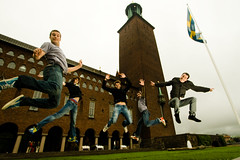 Use conscious control to prevent inversion sprains and turns by not allowing the ankle to invert (turn sideways) when rising to toe during push-off in running and jumping, and coming down during landings. Watch for healthy ankle and knee stability and placement throughout the team season.


