Fast Fitness - Eighth Group Functional Training: Spine and Shoulder Stability With Overhead Motions
Friday, April 23, 2010
Jolie Bookspan, M.Ed, PhD, FAWM
Here is Fast Friday Fitness - eighth in the series of Functional Fitness Training (Bookspan Basics) to teach your group, teams, classes, students, kids, battalions, or self. In this Bookspan Basic Training, you train positioning and muscle skills to reach overhead with healthy mechanics for the shoulder and lower back.
Assemble your group in neat rows. Stand in front in view of all. Tell them this is a basic, functional physical skill to learn to prevent injurious positioning during overhead motions.
Everyone reaches up. Have everyone notice if they lean their upper body backward to raise their arms. See if their tilt their beltline downward in front or push the hip/pelvis forward. See examples in both photos above and below. Explain that leaning back and increasing the lower spine arch are not a healthy ways to raise arms and that upright neutral spine is a stronger base for their arm movement and uses abdominal muscles.
Have everyone bring their ribs back down to level, pull upper body to upright, and tuck the hip under to straighten the pelvis to vertical and neutral. The motion is like doing an abdominal crunch standing up, without curling forward. You crunch enough to bring yourself to straight and upright. See our short movie of fixing this on Overhead Lifting, Reaching, and Throwing Part II - Lower Back.
Have everyone hold their upper body upright and vertical and notice where their shoulder is and try it again with healthy position.
Leaning back when raising arms increases the inward curve of the lower back, causing a swayback, hyper-lordotic posture. Hyperlordosis is a common source of "mystery" back pain. It comes when you over-arch - usually during long standing, walking, running, reaching, then goes away. People are mystified. Look at both photos again. It is easily prevented by stopping the injurious position then and there. Send your success photos to me at DrBookspan.com.
Make sure everyone breathes. A bad habit promoted by much popular fitness is tightening the abdominal and backside muscles to do minor movements. People hold their breath. Make sure all can do full relaxed belly breathing while holding neutral spine and reaching both arms overhead. Remind all to keep their shoulders down and not raise the shoulders when they raise the arms.
Fast Fitness - Easy Start to Mobilize Shoulder and Scapula
Friday, February 19, 2010
Jolie Bookspan, M.Ed, PhD, FAWM
Here is Friday Fast Fitness - an easy way to learn and feel how to use the often forgotten serratus anterior muscles, for better shoulder mobilization, first introduced in December:
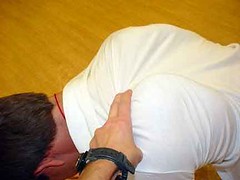
On any surface you are comfortable, go to hands and knees. Keep your arms straight at the elbow. Let your upper body sink under your weight so that your shoulder blades roll back and come towards each other. Your shoulder blades may stick out like wings, photo 1 below.
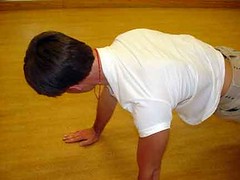
Correct that problem by pulling your upper back to a straighter position, photo 2 below.
Alternately sink and pull upward to correct the winging. Improve by increasing the number and speed you can correct. Use the hands-and-knees position to get the idea. As soon as you have the concept of how to move, use the full pushup position, called plank, to get off your knees and get real exercise.
The standing version of this drill is in my book Fix Your Own Pain Without Drugs or Surgery. Thank you to Dr. Johannes Ernst, who wrote in about using hands and knees to get started:
"I should mention I'm actually doing a variation of the scapular mobilization exercise which I have found to be more effective for me: basically like a push-up, but propped up on knees and elbows. That way I can extend the amplitude of the back and forth movement further than if standing up. That additional stretch does seem to make a difference, and it seems to work some muscles as I can do only about 30 or so before I run out of steam."
--- Read success stories and send your own. See if your answers are already here - click Fitness Fixer labels, links, archives, andIndex. Subscribe free - updates via e-mail or RSS, upper right. For personal medical questions - Replies to Medical Questions. Limited Class space for personal feedback. Top students may earn certification throughDrBookspan.com/Academy. Learn more in Dr. Bookspan's Books.
Fast Fitness - Mobilize and Strengthen With Serratus PushUps
Friday, December 18, 2009
Jolie Bookspan, M.Ed, PhD, FAWM
Here is Friday Fast Fitness - Strengthen and learn to use the often forgotten serratus anterior muscles and learn a good mobilization for your shoulders so that you don't get stiff, and become stuck round-shouldered when driving or typing.
"Serratus" muscles wrap your chest below your armpits. Their sections fan out like your fingers, looking serrated, giving the name. They wrap around your sides to the front, so are further described with the word "anterior." Muscle names are often descriptive, and can be easy and fun to understand. They are important for keeping your shoulder blades in place - but only when you use them to.
My student Yash demonstrates:
1. Hold a push up position with straight not locked arms. This is often called a plank position. Keeping your arms straight at the elbow, let your upper body sink under your weight so that your shoulder blades roll back and squeeze together - photo 1.
2. Correct that problem by pulling your upper back to a straighter position - photo 2
3. Do as many repetitions of sinking and pulling upward to correct the winging that you can at once. Improve by increasing the number and speed you can correct.Coming posts will describe the serratus more and what it does, more on winging scapula, more fixes for it, and more on understanding muscle names and uses. Understanding, rather than memorizing, will help you know if claims for exercise fads and machines will help or not, and to not feel like an outsider about your anatomy and health. No medical degrees needed to understand your own body.
"I enjoy the all day exercises using squat and lunge for my daily activities. Thank you for sharing your philosophy.
"However, those exercises are mainly for lower body. I would like to ask if there are good all day exercises for upper body parts i.e., shoulder, neck.
"I found some stretches for shoulder and neck that you introduced.
"Thank you and best regards, Vietanh"
This is a great question and understanding that fitness is something that you do during real life. In gyms and health centers, even therapy settings where people are going there for the purpose of fixing and increasing function, they sit waiting in terrible unhealthful positioning - photo at right - waiting for a class or activity for health. I have read fitness books saying the posterior shoulder is "difficult to target." Hold your shoulders straight, rather than letting them slump forward. You will get built in upper body functional exercise. Apply this to exercise, to lifting, sitting, sewing, all you do.
Look at your many hours each day of real life - when you prevent round shoulders with retraction to neutral, you are getting upper back extension exercise. When you sit and bend and lift right instead of rounding forward, you get healthful, functional upper and mid range back extension. When you use neutral spine to walk, run, kick, and jump, by extending at the hip instead of allowing the lower spine to increase in arch passively into hyperlordosis, you get healthful lower back extension and abdominal exercise at the same time. It is the abdominal muscles that will flex you forward to straight, rather than overarched. They only do this when you deliberately use them. Strengthening alone does not create movement to healthful position. Healthful positioning strengthens and gives exercise. Look at the photo above again and see that how you really live, not a gym, is your exercise and health.
Apply upper body muscle use for function in daily life:
Using upper back muscles to prevent rounding forward in round shoulders gives continuous built in exercise. This is not forcing, just mobile, comfortable muscle use. How are you sitting while reading this?
There is more to this excellent question. Will come in future posts.
---
Read success stories of these methods and send your own. Questions come in by the hundreds. I make posts from fun ones. Before asking more, see if your answers are already here by clicking labels under posts, links in posts, archives at right, or in the Fitness Fixer Index.
Subscribe to The Fitness Fixer, free. Click "updates via e-mail"(under trumpet) upper right. See Dr. Bookspan's Books. Get certified - DrBookspan.com/Academy.
Fast Fitness - Built in Upper Body and Core Exercise Carrying Children
Friday, May 29, 2009
Jolie Bookspan, M.Ed, PhD, FAWM
Here is Friday Fast Fitness - get better exercise and stop aching back and shoulders when carrying children (or anything else) in backpack carriers or by piggyback:
Put on the carrier (and baby for a fun practice ride or use groceries, etc). Look sideways in a mirror.
See if you round your upper and or lower back forward. See if you lean your upper body backward under the weight. Notice if you increase your lower spine inward curve, are tilting the hip out in back to hold up the carrier.
Straighten upper and lower body segments. You will feel a strong pull on your abdominal muscles when you reduce overarching in the lower spine and prevent leaning the upper body backward. You will feel an upper back workout when you don't lean or round forward.
Use straighter positioning all you can:
It may be "natural" to try to offset loads by hunching and contorting your body, but it still hurts.
Overarching the lower spine makes carrying feel easier because it shifts weight to the spine joints (facets) and surrounding soft tissue, and off the ab muscles. Rounding forward feels easier as it shifts weight to the discs and off the back muscles.
Get more exercise and less joint trauma with neutral posture.
Looking downward with good neck dynamics: Holding healthful position does not mean never look up or down to see where you are going. It means to get natural, built-in upper body exercise, burn calories, and enjoy your time going places with the kids - Tax Preparation Health
Read success stories of these methods and send your own. Questions come in by the hundreds. I make posts from fun ones. Before asking more, see if your answers are already here by clicking labels under posts, links in posts, archives at right, or in the Fitness Fixer Index.
RSS feeds are still going down - Click "updates via e-mail"(under trumpet) upper right. See Dr. Bookspan's Books. Get certified - DrBookspan.com/Academy.
Pectoral (Chest) Stretch - The Most Common Mistake in the Best Shoulder Stretch
Tuesday, May 19, 2009
Jolie Bookspan, M.Ed, PhD, FAWM
Mike Benson has sent several Fitness Fixer inspiring stories. In response to reader requests, he made us this photo set showing, "The most common mistake in the best stretch - How to not get any stretch from the pectoral stretch." I asked him to demonstrate this, because I see this mistake so often. People often "do" a stretch without "getting" a stretch.
Why is this stretch so good? Round-shouldered posture is a main contributor to neck and upper body pain and rotator cuff injury. Round-shouldered posture feels comfortable and natural when the front chest muscles are tight. A common mistake is to stretch the shoulder joint, which does not address this problem.
The purpose of the pectoral stretch is to lengthen chest muscles so that healthier positioning feels natural and comfortable. If you merely hold your elbow to the side, little lengthening can occur - shown in first photo:
Second photo below - changing the position to get the purpose - lengthening anterior (front) muscles that go across the chest. One way is to use a wall to help you press your elbow back.
Turn your body and feet away from the wall.
Your elbow is behind you, no longer out to the side.
Raising the elbow higher or lower changes the stretch.
Experiment until you only feel a stretch in the front chest and no pain or pinching anywhere in the shoulder:
Keep shoulder down and relaxed
Do not make any pain anywhere. The idea is to make things healthier, not to strain, push, force, tighten, grunt, and call that a health promotion activity.
Understand the purpose first. The purpose of this stretch is to lengthen front chest muscles so that tightness does not pull you into feeling that round-shouldered position is the norm or that it is uncomfortable to straighten. Feel the stretch in the intended area.
Use a mirror to help you connect what the position looks like with what it feels like.
Read success stories of these methods and send your own. Questions come in by the hundreds. I make posts from fun ones. Before asking more, see if your answers are already here by clicking labels under posts, links in posts, archives at right, or in the Fitness Fixer Index.
RSS feeds still down - Click "updates via e-mail"(under trumpet) upper right. See Dr. Bookspan's Books. Get certified - DrBookspan.com/Academy.
---
Photos by and of Fitness Fixer reader success Mike Benson
Fast Fitness - Add Balance, Stability, and Portability to Military Press - Handstand Pushups
Friday, April 17, 2009
Jolie Bookspan, M.Ed, PhD, FAWM
Here is Fast Friday Fitness - If you like lifting weight overhead for upper body strength, you don't need to wait to go to a gym, or to get weights or equipment.
Get more exercise, practice balance, and shoulder and arm stability, with handstand dips:
Do a handstand against a wall. An easy way is to stand with your back about a foot or so from a wall, crouch down and put one foot, then the other, high on the wall.
With good judgment, do upside down pushups (dips).
Vary the depth of each dip, speed of each, speed you can do a number of dips, and distance of your hands from the wall to vary the exercise.
Robert Davis sent in his video of how to do handstand pushups. Blogger is still having trouble uploading visuals. Click this link to watch it:
he writes, "I replaced the military press with this. It is portable for one! Ever notice how pronounced male gymnasts shoulders and arms are? They do things like this:) "
Robert was a weightlifter who hurt his back with conventional lifting (bad bending and overarching the lower spine). He rehabbed quickly with Fitness Fixer techniques and has been sending in his success stories one after the next. He writes:
"This was not a very problematic exercise as I had been used to destroying my shoulders with mega high weight LOL. But this is different because of the engagement of muscle groups that control stabilization.
"But yeah, I have been doing that in place of military press and see how it is more beneficial as the stabilizers have to kick in more then being benched or using a machine.
"Once again thank you and I think people should really listen to you. I am glad I did because I have no need to go in to get scanned or be told I need surgery or something silly ;)
"Like I said I am not into pro body building, I just did it to stay "fit" and look fit as I thought it was. But after going thru this, it is not all that functional to pound out reps of heavy weight and not be able to do a plank or walk/sit straight. I lifted enough just to have "lean muscle" but not to be huge. But I realize now this is easily done safely with your methods and I do not need a gym."
--- Read and contribute your own success stories of these methods. Before asking questions, see if your answers are already here - click labels under posts, links in posts, archives at right, and the Fitness Fixer Index. Subscribe to The Fitness Fixer, free. Click "updates via e-mail"(under trumpet) upper right. For answers to personal medical questions - Replies to Medical Questions. Limited Class spaces for personal evaluation. Top students may apply to certify throughDrBookspan.com/Academy.See Dr. Bookspan's Books. ---
In A Whole Big Fix Mike fixed several injuries and made the interesting statement, "I stopped cycling to improve my health."
Back in December, I asked Mike if he wanted to get back to cycling and about his shoulder. While we were working on his story, reader requests piled in by the hundreds. Stay with us and questions will be answered. If I only answer them in order, it will be hundreds more posts before I get to questions arriving today, so make your questions fun and helpful.
Mike wrote his update:
"The cycling didn't cause pain at the time, but created bad posture habits and muscle tightness (shoulder rounded forward after separating collarbone in a crash, tight psoas muscles and hamstrings) which led to pain later. I'm walking more human-like now. Also, the air and traffic around here has gotten worse because of the housing and population boom, so I was having horrible coughing fits. Now I don't, without the aid of any medicine and, I believe, by following your diet recommendations.
"Shoulder: The physical therapist had me doing the trench coat type exercises you've described in your books as not as effective or needed, in many different ways (pictured at right), especially the "closing of the trench coat" which didn't make sense to me because they said I was overly tight in the front and too flexible and weak in the back. The visits there didn't work.
"Instead, I used the two stretches shown by your husband - right angle elbow with hand in air in Fixing Upper Back and Neck Pain, and the hand in the opposite pocket behind the back while leaning sideways, in Nice Neck Stretch."
Standard physical therapy exercise for rotator cuff consists of keeping the elbow close to the waist and rotating the forearm inward and outward, like a flasher opening and closing a trench coat (photo). There are almost no daily activities that need this specific motion, not even opening a door. No one uses their muscles this way (unless you are a flasher I guess). People do these exercises then go back to daily bad overhead reaching and re-injure their shoulder, or wonder why it never heals.
The rationale for doing the trench coat exercise is that strengthening the rotator cuff will heal the injury. Strengthening is not the main issue in most shoulder injuries that I see. Misuse of the shoulder is the root cause. A common counterproductive scene is people "doing shoulder exercises" with their head and neck slouching forward, upper body rounded, which injures the shoulder with each arm lift.
Slouching the upper body forward when raising arms for any daily activity, stretch, yoga, or weightlifting will continue to injure the shoulder. What improvement are you making to your shoulder to do exercises in a way that will injure?
Mike wrote:
"I'm also concentrating on keeping my thumbs facing forward when arms are down in order to help prevent my shoulders from rolling forward. I'm feeling more upright and balanced when doing everyday activities."
I told Mike that the idea is not to hold thumbs forward. The idea is to get the purpose of the stretch so that the chest muscles lengthen enough so that the arm bone is not pulled into inward rotation. The post on this topic is listed at the end.
Mike was also "doing" one of the key stretches but not getting the stretch needed, so no benefit was occurring. He was going through a set of motions to achieve the set of motions instead of to achieve the purpose, which was to restore resting length to the chest muscles. Mike made us some photos of how he was originally doing the pectoral stretch and how he fixed the motion to get the purpose. I will post them soon so everyone can see the difference.
It is common to stretch in ways that does not achieve the purpose, or in injurious ways. Then news stories report on studies that stretching doesn't improve physical performance or help prevent injuries, and no one knows why. It is not difficult to see why: What Does Stretching Do?
Overhead Lifting, Reaching, and Throwing Part I - Shoulder and Rotator Cuff Injury
Monday, August 04, 2008
Jolie Bookspan, M.Ed, PhD, FAWM
The photo at right shows one main contributor to shoulder and rotator cuff pain, and one for lower back pain. Can you see them? Can you see why the person in red is not getting as much stretch in the shoulder as they think?
I see patients for shoulder pain all the time. Their chart says, "normal range of motion at the shoulder," or the chart reads with a number of angle degrees corresponding to directly overhead reach. I ask the person, "Reach up for me please." They lean their upper body backward, increase the inward curve of the lower back, and their hand points directly overhead. Often they do this while tilting their neck and head forward, which puts the shoulder at a position of compression when the arm is raised. I show them how to straighten the upper body upright, reduce the lower back over-arch, and return to neutral spine. I ask them to reach up again. They can't. They shoulder is too tight to reach directly overhead. They were never stretching their shoulder when they thought they were. They were getting the motion from their lower back, not shoulder. They were only leaning backward, adding compressive load to their lower spine joints, called facets. This will be covered next in Part II.
In the photo, note that the head is forward, a major contributor to rotator cuff injury during overhead arm motion. Lifting your arm with the neck and head tilted forward mashes the upper arm bone against the shoulder bones. This compresses the soft tissue between them, including the rotator cuff and nerves that go down the arm. Each small pinch can eventually saw at the area until a rotator cuff tear begins.
Rotator cuff injury is common, even in people who do no overhead athletics, like pitching, martial arts, or kayaking. Reaching upward is common around the house and for exercise. Starting in the morning, you wash or comb hair (or polish a bald head). You pull clothing on and off overhead. You reach in cabinets, wave goodbye, shield your eyes from the sun, open car trunks and hatches, put things up on racks, shop for groceries and put them away in cabinets, lift children, clean curtains and tub walls, put work in overhead shelves - many reaches, all day, every day. At the gym there are overhead lifts, stretches, and arm motions.
Compressing the nerves that pass through the area and go down the arm sets is called impingement. Impingement is not a disease. Someone with a diagnosis of impingement does not have a real diagnosis. Impingement is not a cause of pain, it is a result. If you stop the mechanical cause, then you can stop the resulting impingement. No drugs or surgery or repeated therapies are needed:
Notice your neck and head position when lifting overhead and don't let your head and neck sag or jut or tilt forward. To see if you have the health and flexibility just to stand straight, try seeing of you can stand comfortably with your back and back of your head against a wall. If not, try some posts on upper body flexibility, such as Fixing Upper Back and Neck Pain. Don't force. Breathe. Smile. Relax. It's all for health.
--- Read and contribute your own success stories of these methods. Before asking questions, see if your answers are already here - click labels under posts, links in posts, archives at right, and the Fitness Fixer Index. Subscribe to The Fitness Fixer, free. Click "updates via e-mail"(under trumpet) upper right. For answers to personal medical questions - Replies to Medical Questions. Limited Class spaces for personal evaluation. Top students may apply to certify throughDrBookspan.com/Academy.See Dr. Bookspan's Books. ---
Here is Friday Fast Fitness - rows to strengthen the upper body, practice balance and neutral spine, and avoid lower disc injury from bad forward bending.
Readers have been writing in, excited about doing handstands for the first time or improving the handstand they do to get whole body functional fun exercise. My student Danielle demonstrates:
Shift your weight to stand on one hand. Grasp a hand weight in the other hand
Do rows, and any variety of arm free-weight movements that you want to improve.
There is no need to bend over forward to do rows. It does not train functional posture, and unequally squeezes lower discs outward, which adds to degeneration and herniation forces that are common during bad daily sitting and unhealthy bending. You don't need more unhealthy things while exercising.
Here is Friday Fast Fitness - Dips upside down holding a handstand, for shoulder and arm strength, balance, agility, and fun.
Readers Dave, Nine-Volt Terry, and others asked about dips. You don't need weights and equipment to increase strength. Body weight can be used in many fun ways. Fitness Fixer has shown how to do an easy handstand, then last Friday featured a short movie to learn a regular handstand - Fast Fitness - Step Up To Handstand.
This week - use the handstand for more:
Hold a handstand the way you are safe and comfortable.
Bend your elbows to lower toward the floor like a pushup, then push to straighten.
Increase how deep you can dip and how many you can do and push back up again.
These dips are safer for the anterior (front) shoulder than conventional dips which are done by leaning or hanging on hands while upright, and bending elbows behind you to lower and raise. They can work like a Safer Overhead Military Press. Make sure you don't have glaucoma or uncontrolled high blood pressure before doing these. Breathe and stay relaxed instead of tightening.
To increase skills, work until you can do handstand dips without a wall.
"My Yoga teachers uses that, but you hold you legs at a right degree angle to the floor. It forces your back to be straight. Seems to me it sets you up for more shoulder action. I don't think I'll ever be able to do a handstand without the wall."
The handstand against the wall can be done with legs straight or bent as Ginger describes, or a variety of other stretches. However bending the legs at right angle, or any angle, does not "force" a straight back. Rounded back can still occur. Many people with tight hamstrings wind up rounding the back doing this stretch as Ginger describes because the back is the only place they can get the stretch from and they do not know how to transfer the stretch to the hamstrings. The shoulders also can be in any posture or level of "action" from good to bad depending on how much you know about posture and allow to happen.
The photo at right shows five of my students demonstrating the easy wall handstand in both positions. First at right in the foreground is Diana who hold straight good neutral spine. Next, also in good neutral spine is 67 year old Leslie who starred in the post Are You Stronger Than A 67 Year Old Lady? Click the post to do your pushups with her every day. Third in the middle, Johanna demonstrates right angle (photo taken just before reaching parallel to floor). This can be a fun stretch for hamstrings without loading the lower back.
Most important, use a straight handstand position in neutral spine to train straight body position against resistance, then transfer that knowledge to daily life. If you use the right-angle pose alone you do not learn that.
All my exercises are developed to be more than exercise alone. Instead of just "doing a move" or "holding a pose" use them to train how to move out of bad positioning into healthy position for everything you do.
The post Fast Fitness - Fixing Your Handstand to Neutral Spine shows a short movie of letting spine sag in the handstand and how to fix it so that you can train what to do when you are walking around, running, lifting weights, and just enjoying life. Instead of "doing" exercise, restore real life.
For doing handstands without the wall, it’s just real life balance and stretch training - a post soon will cover how.
Fast Fitness - Easy Handstand for Balance, Upper Body Strength -The Movie
Friday, May 09, 2008
Jolie Bookspan, M.Ed, PhD, FAWM
Here is Friday Fast Fitness - a quick, safer way to try a handstand. Standing on hands has many health and strength benefits and can be easily practiced in this way.
My student Dennis, Olympic medalist in wrestling, demonstrates in this short movie. Click the arrow to watch the movie:
Stand with your back about a foot in front of a wall, and crouch to put your hands on the floor (avoid slippery surface)
Put one foot high up on the wall, then lift the other foot up too
To get down, step one foot back down, then the other
Keep breathing. Smile. Relax. Send in your own photos of trying this. Be safe and have fun.
When you stretch and exercise, especially if you stretch and exercise to improve your health, remember that the purpose is not to recreate unhealthy movement habits.
Two similar letters came in recently.
Reader Tina wrote:
"Thanks so much for your posts on stopping upper back pain. I have stopped my upper back pain. But, when I pull my neck and shoulders back, I get pain in my lower back. Which stretches should I do to stop this pain?"
Alicia wrote:
"I recently stumbled upon your articles on the Internet about how to reduce back pain. Thanks so much for providing this information! I am experiencing less pain for sure already… but I have a question. When I am keeping my neck back and shoulders back and correcting the lower back arch, I get a pinching sensation in the middle of my back. What am I doing wrong?"
Tina was doing a common unhealthy movement habit. She didn't need stretches to fix the pain; she needed to stop old injurious movement habits. Tina was leaning her upper body backward thinking she was pulling her shoulders back. Leaning backward is not correcting rounded forward shoulders, even if it seems to move the shoulders rearward. The shoulders have not moved at all just stayed rounded while the upper body pinched backward at the lower spine.
The photo at left is a performer who had just finished a trapeze performance. All the exercise and stretching she did every day didn't change her bad positioning habits.
Leaning the upper body backward (shown in the photo, left) increases the inward curve of the lower back, making a sharper angle between the pelvis and the lower spine. That increases the normal lordosis (inward lumbar curve) to hyperlordosis (too much inward curve as in the photo), which put painful pinching compression on the area. Look at the strip on her leotard. It tilts forward at the front hip and back at the back of the hip. It should be straight up and down, which is part of holding neutral spine.
The photo also shows shoulders and upper back rounded forward, and the neck and head jutting forward.
Slipping into familiar unhealthy ways of moving may be habits that occur without thinking. You need to think a bit.
Alicia was just pulling back so tightly that she pinched the area between the shoulder blades. There are sources that say that you should squeeze shoulder blades as if holding a penny between them to fix posture, but of course, that is painful and too tight.
Alicia wrote back:
"Thanks! That helps actually. The pinching was in my upper back, but it's gone now! Thanks so much for responding to me. I look forward to your class in July. Alicia"
Pinching back does not fix posture or stop upper back pain. Instead, stop the causes of the rounded shoulders and the pain.
What To Do
Three short articles show how to understand and fix the causes:
Prevent Back Surgery shows several photos of how people learn the upper body back or tilt the hip out in back during several common exercises, stretches, and daily activities. Both increase the pinching compression on the lumbar spine.
Remember to think and watch for causes instead of going through the motions of exercises and stretches.
--- Read success stories and send your own. See if your answers are already here - click Fitness Fixer labels, links, archives, andIndex. Subscribe free - updates via e-mail or RSS, upper right. For personal medical questions - Replies to Medical Questions. Limited Class space for personal feedback. Top students may earn certification throughDrBookspan.com/Academy. Learn more in Dr. Bookspan's Books.
Here is Fast Friday Fitness - if you have been afraid to try a handstand, here is a quick easy way to have success. You will strengthen your hands, wrist, arms, shoulders, upper body, and core, practice balance, and get blood circulating.
Crouch down near a wall (avoid slippery floor)
Put one foot high up on the wall
Lift up the other foot
To add a nice stretch on the hamstrings, lift one leg away from the wall into a wide split position in the air, as below.
If you have uncontrolled glaucoma or high blood pressure, ask your care providers first.
Click here to see a quick video showing how to change sagging spine to neutral spine.
Like a Bonsai Tree Your terrible posture at My dinner table
The photo above shows an injurious positioning called "a forward head." A forward head position presses cervical (neck) discs outward, causes upper back and neck pain often called "upper crossed" syndrome, and can press the nerve going down the arm, leading to arm pain and hand/finger numbness. Jutting the chin upward with the neck forward can, over time, create a spondylolisthesis (vertebral shifting). Raising the arm with the shoulder rounded and the neck forward adds to shoulder and rotator cuff injury.
Check yourself for a forward head position when eating and drinking (and on the phone):
Corner of the jaw is far forward of the shoulder
Neck tilts forward
Jaw juts forward
Neck pinches backward, with high compressive force
Shoulder rounded
Don't round your back or jut your chin forward. Instead, keep chin in when you eat and drink and talk on the phone. To look upward, get the upward motion more from straightening your upper back, and not from one joint in your neck. The neck is not a hinge joint.
Don't rely on, "Keep ear over shoulder" thinking that is straight posture. You can see in the photo that the ear is over the shoulder, but the neck is craned badly.
Use healthful positioning for built-in upper body muscle exercise and easy pain prevention. Check yourself sideways in a mirror. Watch other people eating and drinking for an easy reminder. Happy Holidays.
Fast Fitness - Upper Back, Shoulder, Triceps, Arm, Wrist, and Hand Stretch
Friday, December 07, 2007
Jolie Bookspan, M.Ed, PhD, FAWM
Here is Friday Fast Fitness - nice stretch for hands, upper back, and everything in between.
Stand with your back about a foot from a solid surface
Reach upward and backward to place both hands on the wall, all fingers facing downward
Press, lifting upward, keeping the stretch in your chest and upper body.
Vary the stretch by straightening elbows more.
Do not pinch your spine backward like a soda straw at the lower back, which increases lordosis (causes hyperlordosis). Tuck hip to neutral to stop compressive pain in the lower back. Here is how.
Breathe. Smile. Feel good stretching your upper back out of forward-rounded posture.
This is the first part of a great reader story. Mike has been fixing many things. Pain started with a local radiating pain, then became much other pain. Mike looked for something to fix the first area, then ably used other techniques.
Mike writes,
"I'm sorry it's taken so long to write back. Along with teaching and family time I've been taking a graduate class and I've just finish my final project for the class. Now I have time. Here goes.
"Back in 1983 I developed a deep pain and spasms in my right buttock along with radiating pain down my leg. I had been running 40-90 miles per week as a high school and college cross-country/track/road runner. For the past 20+ years this pain has come and gone every week while lying down, walking, and mostly sitting, making it very difficult to work at a desk, sit at a class, and drive. I've assumed it was a type of sciatica and read and tried everything I could for relief.
"The only temporary relief I found was in cycling, which stopped the pain for up to 48 hrs after rides, so I ended up cycling for 20 years, including racing for a team for 2 years. All that cycling caused other problems including a slumped, impinged shoulder from a separated collarbone in a crash, tight hip flexors, allergies from all the car exhaust and desert riding, and too many close calls from SUVs with drivers calling, texting etc. in heavy traffic. I was eating far too many simple carbs for energy on these intense rides. I stopped cycling to improve my health, decrease my risks of collisions, and to save money on all that equipment.
"The pain and spasms in my rear and down my leg increased in frequency and duration. My shoulder was not improving despite a month of visits to a physical therapist. Through searching in the internet I came across Dr. Bookspan's Fitness Fixer and books in early 2007. The logical stretches and strengthening moves worked much better than anything I had tried before. One time during a long class my rear and leg were killing me, so I applied a stretch (I learned from one of the books) while sitting in the chair without anyone knowing. The pain went away for the rest of the class. (Since applying Dr. Bookspan's shoulder retraining) my shoulder rarely bothers me and I've gone months without any pain in my rear and down my leg.
"I've also been enjoying Jolie's books for the sections on nutrition, spirituality, mental focus and general health and exercise advice. Working on all the parts at once seems to help the individual parts even more. I'm now working on walking comfortably without orthotics (it's getting better) and figuring out why my left knee and right hip pop so much. I'm very fortunate that I'm without pain now though, thanks to Dr. Bookspan's advice.
"I've attached some photos of the (hip) moves and stretches that work for me. Thank you! Mike "
Just as I was uploading this post today, Mike wrote me:
"Just wanted to let you know that my wife had a lot of pain and tightness in her hip yesterday from squats without warming up enough and possibly poor technique. She was very uncomfortable in any position, even lying down. I showed her how to do the hip stretch that worked for me, from your book, and it IMMEDIATELY, stopped the pain and tightness and she still feels great the next day! Mike"
I asked Mike about his statement, "I stopped cycling to improve my health." His story will continue, I hope next week.
Friday Fast Fitness - Better Shoulder and Triceps Stretch
Friday, September 28, 2007
Jolie Bookspan, M.Ed, PhD, FAWM
Here is Friday Fast Fitness - Quick shoulder and triceps stretch, without adding new bad positioning. Use this instead of the usual stretch of pulling elbow overhead with the other hand, which usually results in leaning the head forward and arching the lower back. Instead:
Stand diagonally in front of a wall.
Raise elbow (the one closest to the wall). Lean arm, armpit, and body against the wall
Breathe. Relax. Smile. Switch sides.
Do not arch the lower back or tighten any part, or it will hurt and not be right or healthy. That would be silly.
--- Read and contribute your own success stories of these methods. Before asking questions, see if your answers are already here - click labels under posts, links in posts, archives at right, and the Fitness Fixer Index. Subscribe to The Fitness Fixer, free. Click "updates via e-mail"(under trumpet) upper right. For answers to personal medical questions - Replies to Medical Questions. Limited Class spaces for personal evaluation. Top students may apply to certify throughDrBookspan.com/Academy.See Dr. Bookspan's Books. ---
Better Stretches for Swimming - Cook Strait Update
Monday, September 24, 2007
Jolie Bookspan, M.Ed, PhD, FAWM
The September equinox was this weekend. At the moment of the equinox, the center of the disk of the sun crosses the equator. The northern hemisphere comes into Fall while the southern hemisphere begins Spring. For the day before and after that moment, the entire apparent disk of the sun passes the equator, and night and day are approximately equal length all over the world.
Japan celebrates three days before and after the equinox as a time for life reflection, looking forward and back. A Mid-Autumn Festival of the second of three fall harvests is celebrated in many East Asian communities around this time on a varying lunar calendar. The full moon closest to the Autumn equinox is the Harvest Moon, lighting long evenings of harvest work. The moon all during the month of the Autumn equinox is the Wine Moon, a good time for grape harvest, occurring (usually) around September in the northern hemisphere and March in the southern hemisphere.
With this equinox, the weather is warming in the Southern Hemisphere, meaning increased swim training for New Zealander 'Dr. Ernie' (blog name).
"This phase has been one of knuckling down. So here goes: "Cook Strait Swim: Phase II "Now it gets serious.....
"On June 6 I completed my last open water swim in Wellington Harbour in water temps of about 14 C: It felt really cold, the coldest I've experienced. The swim lasted 45 minutes and I noted that afterwards I didn't shiver at all -- a clear sign of acclimatization. I was advised by all to start serious swim technique and endurance preparation in the pool.
"I met with Phil Rush -- the man who has crossed the Strait seven times (including a double-crossing) and who holds the world's record for a triple crossing of the English Channel. He will be piloting the support boat for my attempt, which will hopefully be in February 2008. His advice: swim, swim, swim -- get up to 40 km/week by December (approx 25 statute miles or 21.6 nautical miles), and then be ready to take a 6-hour test in early January. In the test I will have to demonstrate that I can sustain at least a 3 km/hour pace for the 6 hours (a little under 2 miles per hour, a mid-training pace).
"Since July, I've been meeting with my coach, a former Olympian (I'll not mention his name until I've made it successfully across the Strait) and it's been hard going. But very necessary. What I assumed I could do on my own proved to be incorrect. For one, basic aspects of technique have been clarified and my entire stroke has been reworked in the past two months -- a good thing because I don't have a competitive swimming background and I've been doing lots of stuff to create drag. If' I' m to make it across the Strait I'll have to be extremely efficient. And I'll have to be able to keep up pace to stay warm. So my coach had done several important things: first, he's forced me to realign my body position, stressing posture, line and balance; second, he's pushed high-intensity sprint and interval training in addition to long distance swims. I plan to continue weekly lessons through the end of the year."
One of the things Dr. Ernie and I have been working on is better swim stretches.
Good shoulder range of motion helps swimming. Some experts regard the extra range as always destabilizing for the shoulder joints.
I investigated this over several years in the lab, and found that much of the problem is unhealthful stretches, not the range achieved.
You can have a mobile strong shoulder without developing instability or injuring the shoulder joints and surrounding cartilage and soft tissue.
One counterproductive stretch for most people is pulling one arm across the front of your body. It is usually The Stretch You Need The Least. Click the link for more about why.
A better way to stretch your shoulders is to stop doing this less healthful stretch and do three healthier ones:
Nice Neck Stretch. To make sure you get the stretch as intended and not lean or round forward, do the Nice Neck Stretch (trapezius stretch pictured at right) with your back and the back of your head against a wall so that you do not bring your head forward of the wall as you slide down to the side.

 Leaning back when raising arms increases the inward curve of the lower back, causing a swayback, hyper-lordotic posture. Hyperlordosis is a common source of "mystery" back pain. It comes when you over-arch - usually during long standing, walking, running, reaching, then goes away. People are mystified. Look at both photos again. It is easily prevented by stopping the injurious position then and there. Send your success photos to me at DrBookspan.com.