Ted loves to run. We previously fixed his back pain from running. We kept in touch about all his successes with pain free running. A few years later he wrote, worried that his hip x-rays showed severe hip arthritis and an old hip injury hurt. We again got him back to pain free running. That is what we do at Fitness Fixer. In the New York Times, an article quoted a physician who always had pain after running and said he "had no idea why." More about that follows with what Ted and I did to fix his hip pain from running.
Four years ago, Ted came to me with back pain from running. He had been running with too much inward curve in the lower back, which is a common cause of lower back pain while standing, walking, and running. We stopped his back pain from running by teaching him to reduce the too-large inward curve to neutral spine during running and daily life - Back Pain From Running.
A year later, he wrote back saying that since his back pain was completely gone (plus a few other things we fixed in the interim), he noticed some hip pain. He had been running with the foot turned out (duck-foot) and wrote, "A straight push off after the foot-strike made the pain go away - Runner Fixes More Pain With Straighter Push-Off.
Earlier this year Ted wrote that his doctor said his x-rays showed arthritis in both hips. I told Ted not to let doctors scare him into anything rash (surgery, giving up running, taking medicines that cause other problems, and so on). Often the arthritis or other abnormality that shows up on an x-ray is not the cause, or only cause, of pain.
The New York Times recently ran an article quoting the President of the American College of Sports Medicine (ACSM) as saying he (the president) "Has no idea why his knees are sore after each time he runs." The article also quoted several prominent physicians saying, "Most folks should not go (to doctors), because most general doctors don’t know a lot about running injuries. Most docs, often even the good sports docs, will just tell you to stop running anyway, so the first thing is to stop running yourself. In fact, because you probably will have to make a co-payment if you see a doctor, you will be adding insult -the fee - to your injury."
In a study reported at a recent meeting of the American Orthopedic Society, Dr. Matthew Silvis did MRI scans of the hips of 21 professional hockey players and 21 college players. Results showed 70 percent of the athletes had abnormalities, More than half had labral tears, which are scary looking rips in the cartilage that holds the leg in place in the hip bone. None had pain, or only minimal discomfort that did not affect their playing. The same is true for rotator-cuff tears. Studies have demonstrated that about half of all middle-age people with no shoulder pain have these rotator-cuff tears that show on scans but they have no pain or symptoms.
I wrote to Ted with several things for him to check and fix about his body mechanics. He replied:
"I used your ''Better Exercise on Stairs'' article to go Pain Free up stairs (which I had not been able to do for 8-months)
"Thus Encouraged, I ''flattened'' it out, and used the Same Mechanics to do AN EXTREMELY Slow Jog on my 20-min Sunday Walk/Jogs. which have been PAIN FREE.
"The doc looked at my x-rays, told me he had NO idea how I could run on my arthritic hips, had me demonstrate the Flattened Better Exercise on Stairs Method, I explained my 41 year Love of Running....and he said ''You've already figured it out, keep doing what works and YOU call ME if you need to come back.''"
Ted didn't need to go back to the Doc, but he did write to me:
"Sorry to bother you Dr. Bookspan, "In my running you helped me with my back, then you helped me with my knee, (and shoulder).
"I may be pushing my luck here, But NOW my hip flexor (psoas) is inflamed and essentially my thigh is swollen. By paying attention, I found the pain in the hip is in front, about where a tendon would attach to the hip (not the ball joint as I had feared).
"QUESTION--is there an isolation exercise for this tendon??? assuming there is one (I didn't pay much attention to Anatomy in Pharmacy School). What would be some good re-hab exercise/stretches?? This is an old injury from catching my foot on the upswing while running across a tarp spread over the track."
I gave him a nice stretch for the front of the hip where the leg meets the body (anterior hip).
Ted wrote: "Thanks for the quick response
"I went out this morning and did 40-minutes (ohboyohboy) PainFree
"I'm game for any other techniques (and am reading all your web site info…)
"This has added literally YEARS to my running starting 4 years ago when you helped me fix my Back Pain."
Then Ted went walking around downtown on concrete surfaces. He wrote that he was in pain again. I sent him to all the anterior stretches in my book Stretching Smarter Stretching Healthier. Ted replied:
"Dr Bookspan,
"......WOW.....
".....I just got the book last night, "was hurting from a lousy 20-min run, "looked up ''quad'' and ''hip flexor'' stretches and was Pain Free this morning.
"Like I told my running buddy this is like a CookBook for Pain Relief,,,,,,,
"I cannot wait to go out and hurt something else."
Here is Fast Friday Fitness - learn healthy floor-sitting, mobilize your pelvis, and use your core muscles and brains at the same time to move out of painful position to healthy comfortable sitting.
Here is a technique to identify if you sit in a way that is associated with lower back pain, and a technique to move out of unhealthful position:
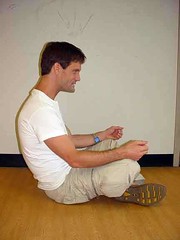
1. Sit on the floor cross legged. 2. Notice your pelvis. Does it tilt backward at the top, so that the lower back rounds outward. This is too much tuck, demonstrated by my student Yash in photo 1 below:
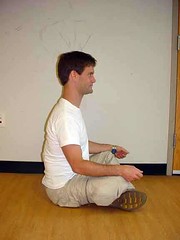
3. Put your hands on the floor right behind your hips. Push against your hands to lift your back upright. Can you feel your hip tilt forward to upright position demonstrated in photo 2 below?
(In the photo above, hands are not behind the hip, to provide unobstructed view of the hip/pelvis corrected from tilted back to vertical)
Sit well and you can sit without back pain.
If your hip is too tight to move out of unhealthful tilted position, then it is likely that you are sitting with your back in painful rounded position.
If you are tight, or do not know how to move your pelvis while sitting, it is often easier to learn to mobilize your pelvis standing or lying down. The pelvic tilt is misused in therapy settings. It is mistakenly thought of as a strengthener or a back pain fix. The muscle work (to strengthen) is minimal. The idea is to learn *how* to move the pelvis so that you can voluntarily move to the needed position, then hold it.
Fast Fitness - Hip Stretch and Spine Stability Training When Stretching Legs
Friday, January 16, 2009
Jolie Bookspan, M.Ed, PhD, FAWM
Here is Fast Friday Fitness - Retrain your standing leg stretches to hold your spine and hip in healthful position, get more stretch to the front of the hip, use your back muscles, practice balance, and learn functional stretching - the way your body needs to move in real life in a healthy way.
When you raise one leg to stretch when standing:
Keep your standing leg straight. Don't bend at the knee and hip, as pictured.
Don't round your back or let your pelvis and hip round under you, as pictured.
Stand straight. Relaxed. Don't force or strain. Breathe.
When stretching, remember function. Why practice a position that is rounded, tight, and detrimental to how you move in real life when you lift your legs. It would look silly and unhealthy to stand up that way. Why stretch that way?
Get functional stretch by lengthening your body enough to be able to straighten out. That is the purpose of the stretch.
Use the new length and your brain to stand straight. Transfer the positioning to real life when you are standing and lift one leg to take stairs, kick, dance, play sports, climb over things, and other life activities. Standing without being so tight that you round your body forward, or just round from habit, is healthier, better looking, burns more calories, and stops many sources of chronic aches and pains.
Send me your photos of fixing this stretch. Doing is the best learning. I will post the photos in a reader success story.
Questions come in by the hundreds. I make posts from selected ones. See if your answers are already here by clicking labels below posts, and links and archives. Read success stories of these methods and send your own.
Have The Fitness Fixer e-mailed to you, free. Click "updates via e-mail" - Health Expert Updates (trumpet icon) upper right column.
A reader wrote in that he tried the "wall test" done by standing with your back against a wall. The wall test is a quick general assessment to see if you can comfortably stand up straight, and if not, where the tightness exists that prevents it. The reader said the test hurt. He was angry and wanted me to warn everyone not to do the wall test.
The point of the wall test is to see if you are generally standing upright, or have tightness preventing healthy stance, not to cause pain by forcing it. If you can't comfortably stand straight, it is likely that you are going about your day in a tight, crooked position that contributes to pain syndromes and gradual spine and disc damage. That is the point of doing the test - to determine the source of the problem right then. Then, see if it is just a bad habit of how you stand, if you don't know how to stand well, or if tightness prevents it. Specific functional stretches easily restore resting length to the area. Then you use the new ability to stand and move in healthy ways.
In the photo, Dr. Clara Hsu stands well while checking a patient. In the photo, the patient looks tight, both at the hip and the front of the shoulder. The patient seems to be straining to pull in her chin. She is lifting her ribs and overarching the lower back to try to get the upper body to the wall. These two compensatory moves are things to check for. Instead, pull neck and chin back loosely. Bring upper body upright by unroundng the upper back, not by leaning back, increasing the angle at the lower spine.
The wall test is a general test, not an exercise. It shows three things:
How you are standing at the moment, and perhaps as general habit
Where bad habit or tightness may be that prevents standing in healthy positioning, for example a forward head, bent or tight front hip where it meets the leg, or overarched lower back
The wall test is done a second time as immediate feedback after doing specific retraining stretches, to see how well you have achieved the purpose of the stretches to restore normal length of these areas.
The wall test is a general, not absolute measure. The assessment works for most body types. Many people who think that larger lower body prevents upright stance, may actually be standing bent forward at the hip.
Straining to stand straight is not healthy straight standing. Making it possible to be healthy is the point. Causing more pain would be silly, and counter to the point. Often it is just a matter of identifying what is straight stance using the wall test, and standing better from then on. If the wall stand is uncomfortable, or not possible, check your standing habits. If there is tightness, then stretch the hip, shoulder or wherever else is holding you in tight bent position.
To stretch front chest and hip to make straight standing comfortable:
Coming soon, Dr. Clara Hsu asked me to tell the story of, "Class is always in session."
---
Questions come in by the hundreds. I make posts from selected ones. See if your answers are already here by clicking links and archives. Read success stories of these methods and send your own.
Subscribe to The Fitness Fixer. Click "updates via e-mail" (trumpet icon) upper right.
Fast Fitness - Don't Shorten Hip When Stretching Hamstring
Friday, December 19, 2008
Jolie Bookspan, M.Ed, PhD, FAWM
Here is Fast Friday Fitness - Get a more functional hamstring stretch, and a built-in posturally helpful functional stretch to the front of the hip at the same time.
When lying on your back to stretch your hamstrings by lifting one leg:
Lie flat. Keep the leg you are not lifting flat on the ground, not bent at the knee and hip, or with upper body curled and neck craned, as pictured.
Don't let your pelvis and hip round under you. Don't let your backside curl up off the floor.
Keep your hip, leg, back, shoulders, and head relaxed, flat, straight, touching the ground.
It is a myth that you must bend your knee to protect your back. If you must bend your knee to protect your back, how are you supposed to stand on one leg and lift the other in real life to climb stairs, kick, and even run and walk, without curling into bent over, old-looking, tight, injury-producing position?
When stretching your hamstrings, remember function. Why practice a position that is rounded, tightening, and detrimental to how you move when you stand and extend your legs. Get stretch by lengthening you body enough to be able to straighten out.
Send me your photos of fixing this stretch. Doing is the best learning. I will publish the photos in a reader success post to come.
Questions come in by the hundreds. I make posts from selected ones. See if your answers are already here by clicking links and archives. Read success stories of these methods and send your own.
Have The Fitness Fixer e-mailed to you, free. Click "updates via e-mail" - Health Expert Updates (trumpet icon) upper right column.
How Much Inward Curve Space Should There Be In The Lower Back?
Wednesday, November 19, 2008
Jolie Bookspan, M.Ed, PhD, FAWM
Reader Carina asked a good question on the post Prevent Back Surgery about how much space there should be in the lower back inward curve. Comments were not accepted by the Blogger software for several weeks, and I could not reply in the comments. Her question is so good, it was chosen for this Fitness Fixer post.
Carina writes:
"Hello Jolie, "Your information is so wonderful. Thanks for this stuff it's priceless.
I have been using the wall trick during the day when my back hurts (How to Feel Change to Neutral Spine). Wow it feels great. Only thing I can't STAY and walk like this. My knees are STUCK bent (or I go back to the big arch). I'd seriously look very odd walking around with bent knees. So here are my questions
"1) How much of my hand should go through when I am standing against the wall??? When I stand at the wall and do it naturally I can stick my whole arm to my elbow behind the arch.
"2) Besides these links you provided from a previous question Fast Fitness - Quick Relaxing Hip and http://windowsxp-privacy.net/?id=198760105 " (Note - the above link didn't come through in Carina's comment; I don't know which it is.)
"is there anything that helps me walk in neutral spine and not looking silly? "Thanks for caring about our backs, Carina"
Carina, great work. You have found that simply changing spinal angle (wall "trick") to reduce overarching works right away to reduce cause of pain. Next, here is how to retrain neutral spine into a normal natural stance:
1) Don't worry about "How much hand fits." It doesn't indicate amount of overarching. Lower spinal angle is what matters. Body proportions change the distance from wall - independent of spinal angle.
If you have too much tilt to the pelvis or you lean the upper body backward, lower spinal angle increases. To reduce an arch that is large, press the lower back closer to the wall.
The post Neutral Spine or Not? shows how to tell if your hip (pelvis) is tilted or straight, and/or if overarching (hyperlordosis/swayback) is coming from the upper body (leaning back). The wall maneuver shows you how to reduce the overarch. Don't press flat against the wall or you'll round like a beetle :-)
While standing at the wall, see if you can do a small "crunch" movement without rounding your upper body forward, to reduce the overly large arch. Movement is just from the hip and mid-torso. Hopefully, you will feel that you easily move the body without bending your knees. That should produce reduced lower back arch. Send some photos if you like and I will take a look.
2) Next, you need to make it possible and comfortable:
Check how you are standing. Don't try to touch the back of the legs to the wall. Just heels, backside, upper back, back of head.
Thank you for already checking the other links and finding the relaxing-hip-stretch. I couldn't tell which other stretch you wrote, but most stretches that lengthen a tight front hip can help. One that is functional for daily bending that you need to do anyway is Hip Stretch While You Strengthen Legs.
Hope to hear more about your successes. Send photos and I can post your continuing success in Readers Inspiring Stories.
---
Questions come in by the hundreds. I make posts from selected ones. See if your answers are already here by clicking links and archives. Read success stories of these methods and send your own.
Have The Fitness Fixer e-mailed to you, free. Click "updates via e-mail" - Health Expert Updates (trumpet icon) upper right column.
Here is Fast Friday Fitness - straighten out first thing in the morning and help your back feel good.
Instead of sitting on the bed first thing in the morning, which loads the discs, try this:
Before getting out of bed, turn face down propped gently on elbows
Hold briefly
Get out of bed without sitting.
Don't droop your head downward, jut your neck or chin forward, hunch your shoulders, or fold back sharply at the lower spine. Find a low gentle position that makes your whole back feel good. The idea is to feel better and straighter, not strain, force, or make your posture worse. That would be silly.
Also do this several times throughout the day. Feels good after long sitting and physical work.
For most people this stretch works well. If it hurts your lower back, go to a lower position. If you flatten completely straight and still feel pain or pinching in the lower back, then how can you stand up straight without the same problem? Don't use this First Morning Stretch until you find why it is not comfortable. One common reason is front hip tightness. Try the Quick Relaxing Hip Stretch.
--- Read success stories of these methods and send your own. Questions come in by the hundreds. I make posts from fun ones. Before asking more, see if your answers are already here by clicking labels under posts, links in posts, archives at right, or in the Fitness Fixer Index.
RSS feeds still down - Click "updates via e-mail"(under trumpet) upper right. See Dr. Bookspan's Books. Get certified - DrBookspan.com/Academy. ---
Reader Joe Blatt recently celebrated his 63rd wedding anniversary. He was a Broadway choreographer and dancer.
He demonstrates how to keep good flexibility and balance through the ordinary daily activity of standing to put on shoes and socks, and tying your shoes.
Read inspiring success stories of these methods and send your own. Before asking questions, see if your answers are already here by clicking labels under posts, links in posts, archives at right, and The Fitness Fixer Index. For answers to personal medical questions - Replies to Medical Questions. Subscribe to The Fitness Fixer, free. Click "updates via e-mail"(under trumpet) upper right. Limited Class spaces for personal feedback. Top students may apply for certification throughDrBookspan.com/Academy. Learn more in Dr. Bookspan's Books.
Here is Friday Fast Fitness for the intercalary year (Leap Year) - Leap to develop ankle and knee stability, leg power, and balance.
Leap to a point in front of you. Then leap back again:
Leap forward, landing on the other foot with soft shock absorption. Don't land hard, which jars joints.
"Stick" your landing, without wobbling or setting the first foot down.
Leap backward to the original foot and place. Hold your landing steady. Try several leaps forward and backward, then change the leading leg and repeat.
This skill is good fall reduction training, and ankle sprain prevention for many terrains.
When landing, keep ankle stable by preventing your foot from rolling to the outside. Info in the post No More Ankle Sprains Part II. Train knee and hip stability by preventing your knee from swaying inward upon landing - Healthy Knees.
--- Read and contribute your own success stories of these methods. Before asking questions, see if your answers are already here - click labels under posts, links, archives at right, and the Index. For answers to personal medical questions - Replies to Medical Questions. See Dr. Bookspan's Books, take a Class, get certifiedDrBookspan.com/Academy.
Fast Fitness - Core Hip & Body, Posture Strength & Balance
Saturday, January 26, 2008
Jolie Bookspan, M.Ed, PhD, FAWM
Here is Friday Fast Fitness - training and challenging abdominal muscles to hold neutral spine. Use this, not as an exercise to "do," but to use to retrain neutral spine. Reader Mike, who did a A Whole Big Fix sent this photo to illustrate:
Hold a plank.
Lift one arm straight in front.
Figure out which is the opposite leg and lift that one. Keep straight spine
Mike writes:
"Here's some more feedback on your exercises: it seems the more planks I do with opposite arm/leg extended, the less my hip pops, so I'm doing those every morning for about 4 sets of 10 sec. holds on each side, along with the side planks. Those seem to set my posture off right for the rest of the day. I'm using my hand and wrist muscles to take weight off the bones, as you've said, and my wrists, are getting stronger.
"BTW: my daughter's badminton coach has a PhD in exercise physiology and she's also a big fan of your site."
Lie over a bed or bench with hips right at the edge and legs dangling
Feel wonderful stretch in front hip muscles
If your lower back hurts, you are probably arching your lower back, as in the left photo, Click and read this post - Innovation in Abdominal Muscles. Correct it by tucking your hip (by flattening lower back) toward the bed - right photo.
Reader Bernie, age 80, supplied these photos. He had registered for my Fix Your Own Back Pain workshop but skipped it to do surgery instead. He returned to me in worse pain two years later. His story how we successfully fix the worsened situation is posted in:
--- Read and contribute your own success stories of these methods. Before asking questions, see if your answers are already here - click labels under posts, links and replies in posts, archives at right, and the Fitness Fixer Index. For personal medical questions - Replies to Medical Questions. Subscribe to The Fitness Fixer, free. Click "updates via e-mail"(under trumpet) upper right. See Dr. Bookspan's Books, take a Class, get certifiedDrBookspan.com/Academy.
This is the first part of a great reader story. Mike has been fixing many things. Pain started with a local radiating pain, then became much other pain. Mike looked for something to fix the first area, then ably used other techniques.
Mike writes,
"I'm sorry it's taken so long to write back. Along with teaching and family time I've been taking a graduate class and I've just finish my final project for the class. Now I have time. Here goes.
"Back in 1983 I developed a deep pain and spasms in my right buttock along with radiating pain down my leg. I had been running 40-90 miles per week as a high school and college cross-country/track/road runner. For the past 20+ years this pain has come and gone every week while lying down, walking, and mostly sitting, making it very difficult to work at a desk, sit at a class, and drive. I've assumed it was a type of sciatica and read and tried everything I could for relief.
"The only temporary relief I found was in cycling, which stopped the pain for up to 48 hrs after rides, so I ended up cycling for 20 years, including racing for a team for 2 years. All that cycling caused other problems including a slumped, impinged shoulder from a separated collarbone in a crash, tight hip flexors, allergies from all the car exhaust and desert riding, and too many close calls from SUVs with drivers calling, texting etc. in heavy traffic. I was eating far too many simple carbs for energy on these intense rides. I stopped cycling to improve my health, decrease my risks of collisions, and to save money on all that equipment.
"The pain and spasms in my rear and down my leg increased in frequency and duration. My shoulder was not improving despite a month of visits to a physical therapist. Through searching in the internet I came across Dr. Bookspan's Fitness Fixer and books in early 2007. The logical stretches and strengthening moves worked much better than anything I had tried before. One time during a long class my rear and leg were killing me, so I applied a stretch (I learned from one of the books) while sitting in the chair without anyone knowing. The pain went away for the rest of the class. (Since applying Dr. Bookspan's shoulder retraining) my shoulder rarely bothers me and I've gone months without any pain in my rear and down my leg.
"I've also been enjoying Jolie's books for the sections on nutrition, spirituality, mental focus and general health and exercise advice. Working on all the parts at once seems to help the individual parts even more. I'm now working on walking comfortably without orthotics (it's getting better) and figuring out why my left knee and right hip pop so much. I'm very fortunate that I'm without pain now though, thanks to Dr. Bookspan's advice.
"I've attached some photos of the (hip) moves and stretches that work for me. Thank you! Mike "
Just as I was uploading this post today, Mike wrote me:
"Just wanted to let you know that my wife had a lot of pain and tightness in her hip yesterday from squats without warming up enough and possibly poor technique. She was very uncomfortable in any position, even lying down. I showed her how to do the hip stretch that worked for me, from your book, and it IMMEDIATELY, stopped the pain and tightness and she still feels great the next day! Mike"
I asked Mike about his statement, "I stopped cycling to improve my health." His story will continue, I hope next week.
Fast Fitness - Balance, Strength, Stretch, and Socks
Friday, November 02, 2007
Jolie Bookspan, M.Ed, PhD, FAWM
Here is Friday Fast Fitness with a new debut - web movies!
Fitness Fixer reader David D of Belgium has been making us many helpful mpegs. This one shows how to get several important physical skills and daily built-in fitness as a lifestyle by simply standing while dressing:
Stand with one ankle crossed over opposite knee
Put on your sock while balanced, safely.
If you want more, stay balanced and retrieve your shoe from the floor and put that on too. Stand to put on trousers and other clothes instead of sitting. The more you use balance, the more balance will develop.
Don't strain or force or round your back or make anything go pop. The idea is to learn to move in healthier ways, not unhealthy ones. The post Ancient Shoe Exercise for Hip Stretch and Balance explains more. Breathe. Have fun.
After reading about success with exercise and stretching over various posts including Monday's Getting More From a Hip Stretch, reader Dr. Alan, sent this photo at right of his mother Pearl, age 97, stretching her hip. The straighter upright you sit, and the farther toward the ankle the leg is placed over opposite knee, the greater the stretch. If you are at your desk, try putting ankle over opposite knee, keeping the lifted knee under the desk. More stretch when low desk height keeps your knee down. Pearl also does the "ankle over knee" hip stretch while standing.
Pearl gets regular leg exercise through good bending as she goes about her busy days - she bends well with one foot in front of the other - the lunge, and with feet side by side - the half-squat. This post tells why this kind of bending gives better exercise, maintains mobility, and prevents various knee problems.
Fast Fitness - Better Posterior Hip, Iliotibial, and Piriform Stretch
Friday, September 21, 2007
Jolie Bookspan, M.Ed, PhD, FAWM
Here is Friday Fast Fitness - Quickly improve a common stretch for the back and side of the hip.
Note step 2 and 3 which slides the supporting leg sideways. That change makes it different from the usual ankle over knee stretch:
Lie face up. Bend one knee to put one foot on the floor or bed, comfortably close to your backside. Other ankle crosses knee.
Notice which direction the raised foot is facing. Slide the other foot (the one on the floor or bed) and knee in that direction. Reader David demonstrates. In the left photo, the raised foot faces left. Move the whole leg on the floor to the left. Feel the stretch increase in the raised leg.
Switch sides. Right photo shows raised foot facing right. Slide supporting foot and knee sideways to the right.
The way this stretch is usually done, without moving the bottom foot, does not stretch the piriform (or pyriformis) muscles much, even though it is often called a piraform stretch. The piriform muscles are external rotators (turn the leg outward). Adding more external rotation with the usual "ankle over knee" does not stretch the piraforms. Changing the bottom foot position with this different stretch adds adduction, which means "moving toward from midline." A second movement action of the pyriform muscles is abduction (moving away from midline), so this new method lengthens it, and can truthfully be called a piraform stretch. Future articles will cover more on piriform.
Don't make this stretch hurt or send pain down the leg. The point is to relax and loosen the area, not tighten, constrict, and impinge. Breathe.
This is another 'ooh' stretch. As soon as you do it right, it feels good and you say ooh.
Here is Friday Fast Fitness - Quickly strengthen and straighten the upper back, improve balance, and learn better shoulder position for reaching.
Last Fast Fitness Friday started this one for a strong base. Now that you have practiced, add the upper body:
Stand on one foot. Lift the other leg in back and bend at the hip until your body is perpendicular to your leg as in the photo, like the top bar in letter T. See how the body is straight in line with the brown field in the photo?
Hold both arms in front of you, parallel to the floor, hands level with, or above your head. Lift from your chest, not neck. Keep your shoulders down and back. Don't hunch or round your shoulder or it will impede raising the arms.
Hold straight as long as you can. Switch legs. Hold straight as long as you can.
Work with a mirror or friend until you can tell straight positioning on your own. Want less? Raise only arm. Breathe. Enjoy.
Related Fitness Fixer - "Unround" your upper back for healthier daily neck mechanics:
Here is Friday Fast Fitness - Quickly strengthen lower back and backside muscles, improve balance, stretch your legs, and learn straighter positioning:
Stand on one foot.
Lift the other leg in back. Bend only at the hip until your entire body is parallel to the floor (like the top bar in letter T) as in the photo. Do not droop your leg down in back or droop your chest in front. Do not jut your chin forward. Chin in. Look in a mirror until you can tell straight positioning on your own.
Hold straight as long as you can. Switch legs. Hold straight as long as you can.
Fast Fitness - Great Hip, Side, Leg, and Iliotibial (I.T. band) Stretch
Friday, August 24, 2007
Jolie Bookspan, M.Ed, PhD, FAWM
Here is Friday Fast Fitness. Stretching the side of the hip and ilio-tibial (I.T. band) does several good things. Here is a fast, healthy way to do it:
Lie flat, face up.
Place legs like clock hands, one to 10 o' clock, the other to 2 o'clock (or wider).
Bring one ankle over the other, leaving the other at 10 (or 2 o'clock). Keep hips flat against the floor, don't tilt or twist. Legs straight. Hold. Switch.
This is an "ouu" stretch because when you do it right, you say "ouu." If you don't feel an instant great stretch, pull both legs more to the side. Ouu.