If your knee pain from running isn't getting better with fixing bad gait, physical therapy, and medical care, check your yoga. Several poses directly twist, overstretch, or pinch knee cartilage. Over time, injury builds that does not show much in people who do yoga and little else, until their knees encounter resisted motion for running and sports, or from a trip or fall.
Not long ago, people in yoga or sports did not intersect much. Now, the previously more sedentary yoga populations try running, aerobics, and sports. Athletes are being told that yoga will give them magic benefits. Knee injuries bloom when they go back to sports, making the staunch yoga camps claim sports are the culprit, when it was the knee damaging motions in yoga and other stretches. The knee is a primarily a hinge joint, like the hinge on a door that only can open and close. The door swings toward you and away. If you lift up on the door, it twists the hinge and eventually loosens it. The door begins to creak and rub and make noise.
Think of sitting cross-legged (tailor style). Your knees are out to the side and your lower legs bend toward you. All is fine at that point. Now picture, as with lifting upward on a door, you lift the foot and lower leg to rest it on your thigh in Lotus position or lifting it in some pigeon poses as in the photo, at right. Unless you outwardly rotate the upper leg fully at the hip, the knee twists, overstretching the lateral (outside) ligament and pinching the medial meniscus and soft tissue.
Often people bend the ankle upwards too, also pictured at right, a separate problem - see Unhealthy Yoga Ankles.
How to picture rotation at the hip? Think of a stapler. Like the door just mentioned, the stapler has a hinge or knee joining two sections, like your upper and lower leg. It opens and closes on the hinge. If you pull the upper or lower part sideways, it twists or shears the hinge. To turn to staple sideways, you need to rotate the whole thing.
Hero pose, (Supta Virasana) begins sitting on bent knees, meditation style (left-hand photo below), which often is fine. The knee hinge closes, like closing a door, normal bending. Then the pose continues by pulling the feet outside of the upper legs, like pulling upward on the door hinge. If you do not inwardly rotate both upper legs at the hip fully, your knee twists at the hinge, overstretching the medial (inside- facing the other knee) ligament, pinching the lateral (outer) meniscus and soft tissue. Lying back, as in the right-hand photo adds prying of the joint to the rotation damage (often people overarch the lower spine too instead of stretch the muscles, an additonal problem). In "W" sitting, both feet face outward. Not a problem for the knee unless the hips do not fully rotate (whether relentless W sitting is eventually is too much at the hip is a separate question). Runner's hurdler stretch is the same issue, one leg at a time.
Even though yoga may call for "doing both sides" and following each motion in one direction with one in the other, twisting both the medial and lateral sides of the knee cartilage by doing both Lotus and Hero will not cancel each other, but can overstretch and degenerate both sides.
Warrior poses 1 and 2 are like a lunge. Check your front knee: - Is it inside the line of your foot? - Do your foot and knee face the same direction?
Sagging inward unequally loads the knee and when the foot and knee face differently, the knee twists under body weight (blue center model, photo at right).
Keep your knee above your foot, both facing directly forward.
Mighty Chair pose - watch for, and change overly-stylized artificial position, not valuable for any functional motion (photo right and lower drawing left).
For chair pose, use outer thigh muscles to hold straight and prevent knees from sinking inward. Use neutral spine instead of overly-arched to practice movement the way it is needed all day for real life. Right-hand drawing below shows fixing.
Make yoga something that benefits your real life movement habits, not trains artificial, damaging, motion you don't even need.
Hindu squats and one-legged heel-up deep bends may not twist the knee as much as pry it. Picture a tool to crack nuts - two handles joined at a hinge, like your upper and lower leg joined at the knee. Imagine putting an object (for example, a soccer ball) between the upper and lower leg and try to close the heel toward the upper leg - if the ball does not compress, the hinge (knee) pries open. That happens with low squats on the toes (heels up) if you have large or heavy legs. If you have slender legs, the heels can come closely, like bending your elbow so that your lower arm rests along your upper arm. Slender legs do this, while muscular athletes may destabilize their knees, leaving them venerable to future injury.
The beginning of one of the pigeon poses is pictured at right. The person pictured is sitting to the side, instead of keeping the back knee and leg rotated to face straight downward. Sitting to the side greatly reduces the stretch, especially to the rear hip's front muscles that need the stretch, but usually no big problem to the knee. When the pose continues to lift the back foot for King Pigeon, if you lift the foot up without facing the knee downward, you twist the knee joint. By turning the whole leg downward, you get a better anterior hip stretch, and when you lift the foot, the knee can bend like a hinge, not twist.
One Legged King Pigeon kneels on the rear knee with that knee bent so only the kneecap bears your weight. To reduce compression, and get a better stretch for your hip, move your back leg further back so that your weight rests on the thigh, not kneecap.
I have taken several yoga teacher certifications. Each gives different, plausible-sounding rationale why knee twist poses help, but the anatomy is just off enough to come to wrong conclusions. In one, they taught to deliberately twist the lower leg on the upper "to protect the meniscus." Twisting does not protect, but twist in a damaging way. There are two bones in the lower leg, allowing some rotation, but twisting injures other structures. Another teacher training stressed extreme knee twisting as a stretch in itself, stating that any increase in motion is beneficial, especially from joints. Knee laxity results. Without much muscle and positioning training, you predispose yourself to instability when giving the knee challenge, like going back to sports, or from a fall or blow. Another certification teacher training taught that knee twisting is beneficial since it allows great range of motion in case you fall down with your knee twisted backward. Sounds plausible for that one fall (unless you fall differently), but for every other day in your life, so much extra space can result that the joint 'rattles' and wears prematurely. In another class we were made to sit in Lotus, then, still folded in Lotus, rise to knees and swivel from knee to knee to waddle around the room, compounding damage with body weight on the twisted strained joints.
In each yoga teacher training and class I take, I hear teachers tell about their knee pain and surgeries. They don't know why. They think they need more yoga and do more injurious poses, getting relief or distraction for the moment, then pain comes back. Movement in general often relieves pain for the moment. No need to repeatedly add injury to get temporary relief. Stop the causes and the pain stops.
There are assertions that many people do these stretches and not everyone gets knee pain, so they must be fine. Smoking and unsafe sex also do not have a one-to-one association with immediately bad consequences every time. Some stretches and movements twist the knee and overstretch cartilage. If you do these stretches and have pain, or just sit or stand with your knees hyper-extended (locked back) even if you think it is unrelated, it is one place to think about.
--- Read success stories of these methods and send your own. See if your answers are already here by clicking labels, links in posts, archives, and The Fitness Fixer Index. Subscribe free - updates via e-mail or RSS, upper right. For personal medical questions - Replies to Medical Questions. Limited Class space for direct feedback. Top students may earn certification throughDrBookspan.com/Academy. Get more in Dr. Bookspan's Books.
Three years ago, Merlene's closest friend died. Merlene, who is 74, lost all motivation. Because she was not exercising, she gained a lot of weight. This is where Ivy came in...
Ivy from New Zealand, frequent success story contributor, wrote me in August about her neighbor Merlene:
"You will be pleased that I have a new lady under my wing so to speak. I lent her your book "How To Fix Your Own Pain Without Drugs Or Surgery." Along with giving her advice she tells me that it has changed her life which pleases me."
I wrote to Ivy to ask her if Merlene would be comfortable telling us more on what she did, so others could try it too. Ivy replied:
"I encouraged her to walk again. At first it was difficult, she had difficulty breathing. I noted that she was walking flat footed and taught her to lift her toes. She complained of back pain - I showed her how to lie on her stomach and lift herself up on her elbows before getting out of bed in the mornings. She has now learnt to put her spine into the neutral position. Re her breathing, I showed her how to breathe deeply. She told me that she rolled her neck every day in a circle - she now does the trapezius stretch plus pectoral stretch instead.
"Instead of bad bending, she does squats and lunges while making the bed, doing the vacuum cleaning, going to the fridge and the like, plus gardening.
I checked in with Ivy a while later to make sure all was still improving, and gave her questions to ask Merlene so I could make sure all was well. Ivy wrote again:
"Today I visited Merlene and asked her some questions. She is stronger, breathing has improved, she is more flexible, can walk further, the back pain has improved immensely. She hasn't weighed herself yet, however, is hoping that there will be a weight loss when she weighs herself next week.
"She finds your books "How to Fix Your Own Pain Without Drugs or Surgery" and your Stretching Smarter book very helpful so I left them with her so that she can refer to them.
"She also tells me that your books along with my help and advice has changed her life for the better. She has lost that negativity and feeling positive about life again.
"Merlene is a very quiet, private lady so I try to treat her in a gentle way. She comes from another country and I gather that life has been very hard. She is so enjoying what she is doing. Most important is the fact that she trusts me plus she is very happy you are doing this article.
"Merlene is happy for you to use her name. Re the photo and title (of the article) she would rather it was your choice. "Hugs Ivy "
How to Fix Your Own Pain Without Drugs or Surgery and Stretching SmarterStretching Healthier, and others, on www.DrBookspan.com/books.
--- Read and contribute your own success stories of these methods. Before asking questions, see if your answers are already here - click labels under posts, links in posts, archives at right, and the Fitness Fixer Index. For answers to personal medical questions - Replies to Medical Questions. Subscribe to The Fitness Fixer, free. Click "updates via e-mail"(under trumpet) upper right. See Dr. Bookspan's Books, take a Class, get certifiedDrBookspan.com/Academy.
Reposting - Physician Told Her Give Up, Fitness Fixer Made Her Able
Monday, August 24, 2009
Jolie Bookspan, M.Ed, PhD, FAWM
Last week, several Fitness Fixer posts did not become viewable after writing and posting them. One reappears here (hopefully) with the rest to follow this week. Photos will not load at all, so I have included links to view them at another page. May all life's troubles continue to be this small :-) enjoy the posts:
Another reader named Lisa wrote in with a success story. This Lisa had not been active for many years. Her doctor had told her the way to stop injuries from running was to give up running. She is now successfully doing marathons, changing to healthy movement, and working as a professional photographer.
Lisa P writes:
"I had done some running in college and wound up with a stress fracture on the ball of one of my feet. I remember the doctor telling me to stay away from running in the future.
"I have enjoyed visiting your site for many months (more than a year for sure) and find your practical, everyday life approaches to body movement and exercise right on. The idea of walking a marathon was a "no-brainer" once I found out that walking was allowed.
"As someone who grew up in a home where shoes were always worn, I never got the chance to let my feet walk around barefoot for any extended periods (or distances). My feet couldn't handle "feeling" everything as they had been encased for so long in any number of supportive shoes.
"I remember reading a post of yours about hiking in flip flops and tried to imagine myself doing anything in flip flops or another simple shoe without a lot of cushy padding and support in "all the correct places." I am using my muscles to adjust to uneven surfaces while walking barefoot or with minimal padding between my feet and the ground. I think this has improved my body mechanics. Doing it myself helps in a way that wearing special shoes to do it for me does not. Time will tell of course.
Walking may take more time than running, but I've become a faster walker with training and will surely realize my goal of completing a marathon in under 6 hours this fall.
"I've made an effort to reduce and or eliminate certain things from my diet such as refined sugars, hydrogenated oils, and processed foods. This most certainly has contributed to the results I get in training. As I near the actual marathon, I will be walking upwards of 30 miles a week. It is amazing how my stamina improves as the miles add up.
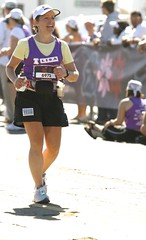
"Attached is a photo of me at mile 25 of The Nike Women's Marathon, the first marathon I completed.
"Oh, one other thing that I have you to thank for is my regular routine of push ups. After every training walk, I do push ups and am currently doing 36. Won't be long before I get to 40!
Going barefoot by itself, or wearing special shoes will not automatically put your foot in healthy position or increase balance skills. You can walk in healthy or unhealthy ways when barefoot, and in healthy or unhealthy ways even in an expensive corrective shoe. You can easily change how you move to healthy ways without needing devices, and save time and money. You can change to healthier eating and reduce a grocery bill greatly, by no longer buying unhealthful food. Click the labels under this post for all Fitness Fixer articles with ideas on each topic.
--- I make posts from fun mail and success stories. Before asking questions, see if your answers are already here - click labels under posts, links in posts, archives at right, and the Fitness Fixer Index. Why not try fun stuff, then contribute! Read success stories of these methods and send your own. Subscribe to The Fitness Fixer, free. Click "updates via e-mail"(under trumpet) upper right. See Dr. Bookspan's Books, take a Class, get certifiedDrBookspan.com/Academy.
Physician Told Her Give Up, Fitness Fixer Made Her Able
Thursday, August 20, 2009
Jolie Bookspan, M.Ed, PhD, FAWM
Another reader named Lisa wrote in with a success story. This Lisa had not been active for many years. Her doctor had told her the way to stop injuries from running was to give up running. She is now successfully doing marathons, changing to healthy movement, and working as a professional photographer. Lisa P writes:
"I had done some running in college and wound up with a stress fracture on the ball of one of my feet. I remember the doctor telling me to stay away from running in the future.
"I have enjoyed visiting your site for many months (more than a year for sure) and find your practical, everyday life approaches to body movement and exercise right on. The idea of walking a marathon was a "no-brainer" once I found out that walking was allowed.
"As someone who grew up in a home where shoes were always worn, I never got the chance to let my feet walk around barefoot for any extended periods (or distances). My feet couldn't handle "feeling" everything as they had been encased for so long in any number of supportive shoes.
"I remember reading a post of yours about hiking in flip flops and tried to imagine myself doing anything in flip flops or another simple shoe without a lot of cushy padding and support in "all the correct places." I am using my muscles to adjust to uneven surfaces while walking barefoot or with minimal padding between my feet and the ground. I think this has improved my body mechanics. Doing it myself helps in a way that wearing special shoes to do it for me does not. Time will tell of course.
Walking may take more time than running, but I've become a faster walker with training and will surely realize my goal of completing a marathon in under 6 hours this fall.
"I've made an effort to reduce and or eliminate certain things from my diet such as refined sugars, hydrogenated oils, and processed foods. This most certainly has contributed to the results I get in training. As I near the actual marathon, I will be walking upwards of 30 miles a week. It is amazing how my stamina improves as the miles add up.
"Attached is a photo of me at mile 25 of The Nike Women's Marathon, the first marathon I completed.
"Oh, one other thing that I have you to thank for is my regular routine of push ups. After every training walk, I do push ups and am currently doing 36. Won't be long before I get to 40!
Going barefoot by itself, or wearing special shoes will not automatically put your foot in healthy position or increase balance skills. You can walk in healthy or unhealthy ways when barefoot, and in healthy or unhealthy ways even in an expensive corrective shoe. You can easily change how you move to healthy ways without needing devices, and save time and money. You can change to healthier eating and reduce a grocery bill greatly, by no longer buying unhealthful food. Click the labels under this post for all Fitness Fixer articles with ideas on each topic.
I make posts from fun mail and success stories. Before asking questions, see if your answers are already here - click labels under posts, links in posts, archives at right, and the Fitness Fixer Index. Why not try fun stuff, then contribute! Read success stories of these methods and send your own. Subscribe to The Fitness Fixer, free. Click "updates via e-mail"(under trumpet) upper right. See Dr. Bookspan's Books, take a Class, get certifiedDrBookspan.com/Academy.
A debate in fad fitness is if you need aerobic activity to lose weight, or if weightlifting is sufficient. The larger issue is that you need to use your cardiovascular system for health.
A 21 year long study from the Stanford University School of Medicine found that older runners live longer and suffer fewer disabilities than healthy non-runners.
All 440 study participants were 50 years old or over at the beginning of the study. All ran an average of four hours a week. By the end of the study, all were in their 70s, 80s, and older, running an average of 76 minutes a week.
At the 19 year mark in the study, 34 percent of the non-runners had died, compared with 15 percent of the runners. Onset of disability was delayed in runners by an average of 16 years.
Lead study author, Dr. James Fries, is almost 70, runs 20 miles a week and plays tennis. He stated the positive numbers for runners was not even as high as compared to average populations, because "the control group was pretty darn healthy." The "health gap" between runners and non-runners increased with age. Fries said, "I always thought that the two curves would start to parallel each other and that eventually aging would overpower exercise. We can't find even a little twitch toward that gap narrowing in the present time."
Study authors also stated that, "The findings probably apply to a variety of aerobic exercises, including walking."
Study was published in the Aug. 11 2008 issue of the Archives of Internal Medicine.
Conventional medical texts originally stressed that exercise would harm elders. That viewpoint led to disastrous decades of needless infirmities among people who could have retained mobility and independence.
In 1980, Dr. Fries wrote a landmark paper of his "compression of morbidity" hypothesis, that "regular exercise would compress, or reduce, the amount of time near the end of life when a person was disabled or unable to carry out the activities of daily living, such as walking, dressing and getting out of a chair."
Stay active, keep moving whatever your age. It is the most important medicine you have.
--- Read and contribute your own success stories of these methods. Before asking questions, see if your answers are already here - click labels under posts, links in posts, archives at right, and the Fitness Fixer Index. Subscribe to The Fitness Fixer, free. Click "updates via e-mail"(under trumpet) upper right. For answers to personal medical questions - Replies to Medical Questions. Limited Class spaces for personal evaluation. Top students may apply to certify throughDrBookspan.com/Academy.See Dr. Bookspan's Books. ---
A study in the American Journal of Preventive Medicine found no evidence of accelerated rates of osteoarthritis among long-distance runners.
Further, weight-bearing exercise like running helps stave off osteoporosis by maintaining bone mineral density.
Study source: American Journal of Preventive Medicine August 2008; 35(2):133-8.
With good movement mechanics, running will not cause early wear on your bones and joints. With injurious poor movement habits, of course, you can wear and injure the joints.
Posts showing good movement mechanics during exercise and daily life:
Questions come in by the hundreds. I make posts from selected ones. See if your answers are already here by clicking links and archives. Read success stories of these methods and send your own.
Have The Fitness Fixer e-mailed to you, free. Click "updates via e-mail" - Health Expert Updates (trumpet icon) upper right column.
Beijing Olympics & Martial Arts Class Teach Common Sense Cooperation
Monday, August 11, 2008
Jolie Bookspan, M.Ed, PhD, FAWM
The opening ceremonies of the Beijing Summer Olympics were a quiet, powerful reminder of mutual cooperation as path to strength, beauty, and peace. Thousands danced in metaphor for healthy society - that we cooperate to create a masterpiece, and each individual is significant. Responsibility and support flow both ways.
Paul and I were in China in 2001 for a martial arts competition. I hope to post training stories with some of the motivating photos from there. Discipline and eagerness to do good were all around us. We haven't been back to China yet, although we live in other areas of Asia for part of each year. In many places where we live there, human, animal, and machine-powered vehicles of every description overflow the roads, in all directions at once, often with no traffic lights or signs to guide. Both lanes may flow in either or both directions at once. Turns occur any place needed at the moment. Problems are infrequent because people are taught cooperation from early age. It is an Eastern philosophy, way of life, discipline, and virtue. Words are not needed. Westerns who are not aware that cooperation and thoughtfulness is taking place mistake this highly evolved order for disorder. When tourists see someone coming their way, they may not not cede way or cooperate, but insist that others are in their way. Traffic accidents frequently involve tourists.
When I teach martial arts classes in the US, I teach beginning students something that startles them. If a blow is coming toward you, don't stand there and get hit. Move out of the way. Some students first insist on trying to bat my arm/leg/head out of the way with theirs. I tell them not to do that. If two arms hit each other, whose will win, theirs or the other person's? You don't know? Better to get out of the way instead. What if it is an incoming baseball bat. Or weapon. Or an opponent you have gravely misjudged,even if they only seem to be an old lady. In Zen the concept is called, "Don't be there." In common sense it is called "duck." Some beginners insist the air is theirs to stand in and they want to meet an incoming object with their body. Instead of ducking, or at the least, deflecting it without damage to any party (or maybe training some discipline and arm hardening techniques), they throw their arm up to meet mine, then depart class cursing and exaggerating to administration that they broke their arm, and that they were right to deliberately disobey the teacher who was teaching a valuable lesson called, don't hurt yourself or others. In class, I give the students a moving drill. They practice a specific footwork drill to keep them moving. I walk around the class - right in their way, one student at a time. They are confused. Some try to push or hit me to get me out of *their* way. Some try to stand still to resist, but get deflected off balance. This continues until one student remembers the point of the lesson. They get the smart idea to go *around* me. The message - polite, cooperation. No confrontation. No hitting someone in your way, or believing no one owns the ground but you. Just smile and say excuse me. It seems to be a titanic message to some.
Click the arrow to watch group traffic cooperation in this short movie from a street in Vietnam.
Paul and I are comically (to locals in the street) co-occupying a tiny front basket of a bicycle rickshaw. Locals routinely travel by pedicab, but our height and Paul's epic shoulders blocking the driver's view and feet at the same time caused so much merriment by on-lookers that it won us many new friends that day. The driver looked to weigh no more than 100 pounds (45 kilos), pedaling a steel bicycle weighting at least 200 pounds (90kg). In another post I will tell of Paul's and my ride on an Olympic bobsled on an actual competition track. A professional driver took first seat of the 4 man sled, and we put Paul in second seat, as it was the only place for his long legs. For new readers, Paul is almost 7 feet tall (2 meters, 13cm). We were supposed to have a 4G ride (4 times the usual pull of gravity on earth), but Paul's giant feet, it turned out, prevented the driver's elbows from moving enough to steer the 15 sharp turns. We got quite an extra ride - the wildest the driver said he ever had. To be continued in a future post on g-forces.
China posts to come - Athletes are afraid of the squat toilets, why some Chinese citizens wear masks, Eastern societal practices that promote physical health through advanced age, answers to reader questions that pile in, and more on Olympics and human potential.
See if your questions are already here - Click the labels below for more posts on each topic.
Find posts on your favorite topics: Click and bookmark the new Fitness Fixer Index.
Students Balances, Listens, Fixes Father's Back Pain
Tuesday, June 03, 2008
Jolie Bookspan, M.Ed, PhD, FAWM
My student Ginger sent the photo at right taken on her recent camping trip. Don't try this at home. It takes balance training, concentration, and a few changes to standard back bend technique.
Ginger is distributing the stretch along the spine so that no one area is compressed at an unfavorable angle, and is contributing most of the leg extension from the hip, not lower spine. More safe back extension stretch and strengthening methods will come in future posts.
Ginger is a good student who makes good use of my classes. Last week, while visiting her parents, she was out walking with her father. She told me that her father said that his back hurt from the walking. She looked, and saw that her father was standing and walking with too much inward curve to the lower back - hyperlordosis (swayback). Standing with the lower spine overarched is a slouch that compresses the spine unevenly downward, pinching the joints and soft tissue at the back of the lower vertebrae. Overarching is a large hidden cause of lower back ache during walking and running. This slouch is not fixed in the bone, it is a posture that is easily corrected. It does not require strengthening the back or core muscles, just using the ones you have. In moments, Ginger showed her father what I taught in class - how to change a slouching overarch to neutral spine. Ginger's father said the ache disappeared right there, and that was all there was to it.
The article Innovation in Abdominal Muscles gives an overview, and the comments give a link to another post with a short movie showing the concept.
If you want a whole book showing the concept, several techniques to achieve and use neutral spine, and examples of use in all daily life, try the book The Ab Revolution™ Third edition expanded. Part I of the book shows daily use without needing any exercises. Part II shows how to exercise using neutral spine to get more exercise, healthier exercise, and use abdominal muscles functionally to stop unattractive and damaging overarching.
Raina and several other readers asked about plantar fasciitis.
On a house, a fascia is a flat horizontal surface just under the roof. In your body, a fascia is flat fibrous tissue that wraps your muscles and soft structures. You have fascia in several places. One is across the bottom of your feet. "Plantar” means the bottom of your foot that you "plant" on the ground. Your plantar fascia is the fascia on the bottom of your foot. Plantar fasciitis is an inflammation (-itis) of the fascia on the bottom of your foot.
Normal Plantar Fascia Action When you walk or run with your feet facing straight ahead, the line of bending of the foot is straight from front to back. Each step gives you a nice, built-in small stretch across the bottom of your foot. As you walk, run, jump, and move, your plantar fascia transmits body weight across your foot. It is part of shock absorption for your entire leg.
How Bad Movement Mechanics Hurts Several things can make the fascia tighten and hurt. Here are three. More to come in future posts:
1. When you walk or run with feet facing outward, the fascia loses the normal stretch. Over years of not getting its normal stretch, it becomes tight. Walking with feet facing outward also puts sideways forces on the fascia with each step instead of the needed stretch. Walking with poor shock absorption, banging down heavily with each step can amplify strain forces on a tight fascia. Every step you take on a tight fascia yanks on the heel where it attaches. Eventually the heel and bottom of the foot get irritated from the yanking and start to hurt. Irritation can eventually cause the bone to thicken to protect itself - a heel spur.
The tighter your Achilles and foot fascia, the more "normal" it feels to walk toe-out. In a circular problem, walking toe-outward is a common fascial tightener. It may be "natural" with tightness, but can increase tightness over time.
2. Letting ankles constantly sag into pronation (flattened arches) is another fascial strain. Keeping body weight more evenly around the sole of your foot, not pressing and downward on your arches, lifts the weight off the arch. Reader David from Belgium made us a great short video of easily changing from rolling in on the arches to holding straight in Fast Fitness - Fix Flat Feet, Pronation, and Fallen Arches.
3. Hard sole shoes and some fasciitis braces stop the sole from getting the normal lengthening while walking, stopping the pain from the stretch, giving the false impression that the injury is lessening. A negative cycle continues of shortening and continuing the source of the injury. Injections briefly make the area more prone to injury. Pain pills allow you to continue the injury process without pain telling you that it is wrong. Several kinds of anti-inflammatory and pain medicines interfere with healing. Wearing high heeled shoes raises the heel, shortening the length of the Achilles tendon, putting less stretch on the tendon, the lower leg muscles, and the fascia of the foot.
Fasciitis can be quickly stopped. It does not have to be chronic. "Doing" a few stretches does not undo a lifestyle of shortening, tightening, and straining. Forcing tight, artificially straight position instead of creating the length and use of the area that allows healthful motion, can create more pain in other segments. Use your brain and learn good body movement to allow it to heal and be functional.
Helpful links to move in healthy ways to stop plantar fasciitis:
The book Fix Your Own Pain Without Drugs or Surgery has a section on fasciitis, the many unhealthful lifestyle contributors, and simple lifestyle fixes to build into daily life and your exercise classes.
Feeling Better Than She Ever Has Part II - Fixing Herniated Disk and Reclaiming Active Life
Tuesday, April 15, 2008
Jolie Bookspan, M.Ed, PhD, FAWM
Barbara lives in a little town of 300 people in Yukon Canada - map at right. Part I of Barbara's story last Wednesday described why it didn't take six weeks to fix Barbara's herniated discs and severe sciatic pain and numbness, but it was six weeks until the "light went on" and she did the things to stop the cause of the injury, so it could stop hurting and start to heal.
Here is an insider's peek behind the scenes week-by-week:
"Dear Dr. Bookspan, "This is a bit of a long one, and probably reaffirms everything you've ever received in hundred and hundreds of emails and stories, but I wanted to share this with you anyway. I can’t thank you enough for working hard and sharing all your knowledge. I am almost completely pain free!
"After 6 weeks of severe sciatic pain and numbness and weakness of my left leg and foot, something just clicked on Thursday night and I became more determined than ever that I could get rid of the pain. Through your website, the Fitness Fixer, and reading lots of personal stories (on your web site and book), I realized that I had to fix (the) causes. I know this might sound dramatic, but you’ve changed my way of life.
"Pre-sciatica lifestyle: "A cycle of: 1) a few months, everyday, of "power" exercising with all the unhealthful postures and movement habits you talk about, then sitting at the computer in all the unhealthy ways you talk about and drinking coffee and smoking, feeling like I’d accomplished something in my day; 2) followed by a few months of complete laziness (not even power exercising). Power exercising consisted of running (without stretching at all) with bad form, and Hatha Yoga (forcing myself into the stretches and tons of forward bending).
"Sciatica struck.
"First two weeks: "I did absolutely nothing about it. I read stuff on the internet and was convinced from the stories that I had some debilitating disease that would affect the rest of my life. I thought the cause was that I didn’t keep up with my "power" exercising. But, I continued to sit bent forward in a chair, hunched over, bending wrong, doing yoga forward bends, smoking and drinking coffee. I know, how sad."
How to avoid herniating forces on the lower back discs during yoga and fitness stretches for the hamstring:Healthier Hamstring Stretching
"Third week: "Had to go back to work in the morning, teaching 4 and 5 year olds in a kindergarten class; in the afternoon, teaching reading strategies to Grade 1 and 2's - sitting in a chair all afternoon. No longer could I hobble around the house holding my backside and leg - full on activity - and pain, tingling, numbness in my left foot, and total weakness in my left leg. Felt like I was walking around all day with a Charlie horse going down my entire left side. Amidst all my continued Internet searches, stumbled upon your website when a friend said that slight forward bending doing dishes and getting ready in the morning leaning over the sink might be a cause. Your website made so much sense to me - if a slight forward bend is a bad thing, how much more unhealthy would my Hatha yoga program be, with all its constant forward bends. I might add here that the two people at work who talk about slight forward bending being a bad thing continually hunch forward while sitting and exercise using forward bends. Just something I’ve begun to notice."
Major news stories quote physicians saying that back pain is often a mystery and that no one knows why stretching isn't working. My readers regularly report that once they understand the simple principles, they see the unhealthful positioning that causes pain frequently - at the gym, in fitness magazines, and in exercise videos and classes:
"I started with lying on the floor propped up, upper and lower back extensions, pec and trapezius stretches, isometric abs, being continually aware of my posture and not doing ANY bad forward bending. Tried to do the lunges and squats for daily good bending, but my muscles were so weak and I practiced them half-heartedly. I tried to apply them in daily life but life seemed so fast-paced at work and I was in so much pain constantly, that I would get _ way into it and then just try to lean to the side to pick things up - result, I was contorting my body in very odd ways! I ordered a support brace and special support backrest (now I know why I never needed them) and seat cushion for my chair from other web sites, but also ordered your book Fix Your Own Pain, along with a few of your other books."
"Fourth Week: "Limping and terrible pain, my boss told me to visit the nurses station -living in a town of 300 in the far north, we have one general store and a health centre, doctor visits once every two weeks - and take every afternoon off during this week to rest up. He still needed me at work in the mornings. Taking my new prescription of Naproxen and trying the lunges and squats and some stretches but not really trying to apply them to the rest of how I was moving and bending and sitting. I would be in quite a bit of pain coming home from my mornings at work. In the afternoons I would basically throw in some stretches, but generally read (sitting badly) and nap for an hour. A lot of the pain would dissipate after my stretches and a good nap - only to be set into full force the next morning at work.
"Your book came in on the Friday and I was very excited. I read through it and practiced the retraining stretches that show how to restore straighter positioning throughout the day. I felt much better by Sunday night with the stretching. Still only half-hearted attempts at lunges and squats."
"Fifth Week: "Decided to start my morning off by doing my full range of stretches instead of sitting in the computer chair smoking and drinking coffee. I felt pretty good when I left for work. People at work were starting to call me "feisty" saying that I seemed to be walking better (that was probably because of my better posture from applying your method instead of just doing stretches!) Sitting in a chair almost killed me - after 25 minutes in a chair the pain was almost unrecoverable - to be endured for the next hour and a half at work."
Barbara was getting the idea about healthy movement, but was sitting in the same way that causes discs to be pressured. She thought it was "taken care of" because she used a commercial lumbar support she purchased the first week. However she was still sitting in unhealthy ways, right over the support:
"I could manage the pain better with frequent relaxing on my stomach propped up on arms and stretching, but I never felt complete relief until I got home at night. I still didn't realize it was bad sitting position, so decided to get rid of my chair and stand to teach. This was better, but the pain still kicked in(especially in my left buttock!). Once my left buttock got hit with pain it went downhill - down my whole leg, followed by the numbness and severe tingling. Midway through the week I went to see our visiting doctor - quick visit and the prognosis that I had a herniated disc L5-S1. He said it would heal. I was feeling pretty positive about this, as it seemed to coincide with what you say about herniated discs. Meanwhile, the sciatica was taking it out of me. I felt I was always either in pain, or awaiting a painful episode. I made it through, relieved that the weekend was underway. I decided to trying walking - every couple of hours I'd walk on my treadmill for 20 minutes and then do my stretches. I did this two times in the day, and then went for a walk outside in the evening (-35 degree weather so I bundled up really well). My dog and I headed out for what was to be the most agonizing walk for me. Half hour into the walk I started to get that butt pain but I was only half way home. By the time I got home after an hour walk, I wanted to hit the roof and I although I could alleviate some of the pain through lying on my stomach propped up, and stretches, I could still barely sleep. I was also completely consumed by whether or not I had slacked in my posture somewhere along the line while I was walking, or whether I was too tight or loose (still missing the big picture)."
"Sixth Week: "Still determined. Began the week at an all-day staff meeting where I lay on a gym mat on my stomach, propped up on my elbows- all day. Stretching at lunch and a couple of other times I walked out of the meeting to stretch. It almost floored me to do a 20 minute standing stint that we had to do during our meeting. Followed by a 2 hour course via video-conferencing where I did the same thing. When I got home the pain was less and I didn’t want to "over-do" it again, so I gently did my stretches throughout the evening- I didn’t try to walk. Next day at work, the pain was pretty bad from the beginning, but it was -60 degrees F outside and not many kids came to school - more time out to stretch when I needed to. Wednesday - more of the same. I tried to walk at night but got discouraged when I couldn’t walk for more than about 10 minutes without pain. Thursday - same thing, but I almost ran out of the school at the end of the morning to go to the nurses station. (We both wrongly assumed that I had overdone walking, not just walked in injurious ways.) She prescribed more Naproxen and told me to make sure that I walked but more frequent intervals. She also told me to keep stretching, but that lunges and squats were simply out - don’t do them. I kept wondering about this advice as I reread Ivy’s story and looked at the pictures of her doing those amazing squats and lunges. I spent most of my evening on the internet reading and rereading stories."
Barbara was lying face down propped up on elbows for long periods in a way that hurt instead of help. Instead of letting the entire spine gently extend backward so that the upper back "unrounded," she was "folding" a crease at the lower back, increasing pinching in the lower back.
"Friday of the Sixth Week: True Awakening! "I took Friday off work and first thing in the morning while I was doing my usual morning stretch routine, it just hit me! I became so obsessed with my posture, thinking that stretches should magically make my pain disappear, but I wasn’t viewing my body as how I used it during regular activity; I was also very guilty of giving up on certain things when they got "too hard" (lunges, squats). My balance was bad (despite trying to practice it while putting on my socks and shoes), my walking gait was horrible, I wasn’t really trying to do anything that required some effort, and I was continuing my bad habits of resting for hours before I tried to get back up and stretch again. Having reread some of the personal stories, I worked on my walking: feet straight ahead, feet hip-distance apart, heel to ball of foot, using my whole foot to walk - I was so focused on posture that I was holding myself stiff while walking instead of walking naturally with a bit of rotation at the waist). When I thought I was using my muscles, I was really just tensing them right up instead of truly using them. Reading posts and walking also made me realize how tight my Achilles tendon, hamstrings, and hips are. I decided to work on this through my stretches too. Next hour I was back up and walking, and stretching those areas after (using a counter to hold onto while doing a full squat, doorway hamstring stretch, and stretching my hip sitting on a chair rather than lying on the floor). Every hour I walked and stretched, and every walking session was longer, every stretching session I could actually stretch farther! Halfway through the day - now it was time to really engage myself in those lunges and half-squats - just do them and do them properly - no excuses - I need them for everyday life and unless I go beyond what I think I can do, I’ll never get to that point. They’re definitely not just part of an exercise routine, but unless I could do them with strength and stability in my living room, I knew I couldn’t do them in a fast-paced setting when I needed them.
"Time to stop making excuses. I was up and about constantly all day, walking, lunges and squats, stretching. By the end of the day, I can’t even describe my feeling of elation when I went to bed completely pain free, with my left leg hardly stiff at all, and some of the numbness in my left foot gone! Actually having been rather lazy, and in fear of lunges and squats doing more damage, they turned out to be the best stretches and strengtheners...now why wouldn’t I want to use these in all situations to get a beautiful natural stretch during my day! The confidence and calmness that all using your principles, and truly using my muscles to engage in activities is giving me give is fabulous. Not to mention all the energy! This is a new way of life for me. And quitting smoking is not a different story...it’s the same story...and my next step is to look into my eating habits and to quit smoking. It’s my life and my body is a temple...I’m sick of mistreating this temple with lethargy and apathy. No more unhealthy exercises in "power" work-outs and yoga for me...strength, balance and flexibility will is every moment, every day. Now I'm ready for your Healthy Martial Arts book...
"Thank you! Thank you! You (and Ivy) are my inspiration! Wishing for you all joy and true happiness in life (which I know you already have :) ). "Fondly, Barbara
"I'm truly thankful for your hard work and great insight into pain and how to live healthy in every day life!!
"PS I was frightened when I was told I had a herniated disk at L5-S1, and this was great news to me as I know I'm healing and I won't need any physiotherapists, etc. to help me through this! Your book Fix Your Own Pain is amazing - I think I've almost memorized it; two people at work have borrowed it already (including my boss) - I think they're seeing how much it has helped me. I'm thinking about giving your book to people for Christmas."
Summary "take-home" message - Barbara found that she doesn't have to "do" any exercises. That is the difference with this method and others. Moving for daily activities using the retrained healthful positioning stops the source of the injury. At the same time, it just happens to give much built in functional healthful movement. That is how exercise is supposed to be - a natural part of your human life.
There is more good news to Barbara's story, but that's enough for now.
Not long after, I saw Dennis running by at a fast clip, with beautiful neutral spine, good leg and foot alignment, and a light landing with each foot-fall. I asked him why he had asked about running lightly when his running was great. He said he had changed to running lightly after I worked with him on it. I asked if it made a difference and he laughed, "Of course. It used to hurt."
Dennis is muscular and squarely built. He used to leave an impression on the floor when he walked, and had knee, neck, and lower back pain after running.
Getting good exercise with healthy impact is fun, feels good, helps bone density, and probably is good for many body systems that benefit by impact and movement. Getting healthy exercise and enough bone loading is possible without jarring landings and transmitting damaging force to the joints. Dennis did several things to stop injuring his joints during movement:
He stopped letting his arches flatten downward. Using his own leg and ankle muscles, Dennis held neutral foot position maintaining a good arch without needing any inserts or special running shoe - Arch Support Is Not From Shoes.
Stopped letting the knees bend inward toward each other when running, and held neutral foot position - Healthy Knees.
Using the information in my classes, Dennis fixed recurring ankle injuries, and various back neck and other joint pain and went on to win medals in wrestling. His stories and photos will follow in reader success articles to come.
The post Spotting Back Pain During Running and Walking - What Do Abs Have To Do With It? showed the common and painful bad posture of standing with too much inward curve in the lower back, called swayback and hyperlordosis. A reader mailed me an article about gluteal muscles and asked what gluteal muscles have to do with it. The article shows one kind of hyperlordosis, with the hip pushed forward. The drawing at right shows that hip-forward hyperlordosis position (right figure) compared to neutral spine (left figure). The article stated that the hip-forward posture was due to weak gluteal muscles, and that strengthening the muscles would fix the bad posture. The article gave a strengthening exercise of lying on your back and squeezing the "cheeks" of the backside together as if squeezing a coin between them.
Knowing muscle action will help you know why it doesn't work that way:
Your gluteal muscles are muscles of your backside. One function is to pull your upper leg backward, for example, when walking, to pull each leg behind you. The distance between the back of your hip and the back of your upper leg shortens.
If you use your gluteal muscles while standing (not tighten them, just use them to bring about movement) your hip will push forward. That is the opposite of correcting a hip that is forward in bad posture.
Squeezing the "cheeks" of the gluteal muscles together is training a different movement direction than either pushing your hip and leg forward or back.
Another fallacy is that tight gluteal muscles pull the hip so that it pushes forward into bad posture. It is true that tight hip muscles in front will change the tilt of your hip. People with anterior tightness cannot easily bring the leg behind them, which hurts stance and gait. Gluteal muscles cannot get that tight unless you have tetanus. Gluteal tight enough to push the hip forward a few inches would be so tight that you would not be able to sit down. You would tear your backside like splitting your pants.
The key point is that strengthening a muscle does not make it move your body or change your position. If you strengthen your arm, for example, your arm does not automatically wave around or raise over your head. Your arm only moves when you make it move. Strengthening your gluteal muscles will not move your hip for you. Even if strengthening did make any body part move on its own, gluteal muscles would cause a forward hip, not correct it.
Think of asking a dog to shake hands with you. If you want the dog to move his paw up to shake your hand, you do not strengthen his leg and paw. You train the movement and the voluntary desire to bring about the action.
Standing, walking, and running in hyperlordosis is a major cause of lower back pain. Some people stick the backside out in back and others tilt the upper body back with the hip thrust forward. Both increase the inward curve of the lower back and painfully pinch the lower back structures. Although some fitness information and advertisements represent overarching as attractive, even something to deliberately do, it is an unhealthy and weak posture, making it unattractive and undesirable.
Strengthening muscles is good and helpful and fun and healthy, and so on. Strengthening gluteal muscles or any other muscles will not automatically make you stand in healthful position. Stronger muscles do not make you move. You can change to healthful position right now without strengthening. These posts show how:
When you hear that you need various strengthening exercises to correct posture, think of shaking a dog's paw.
--- Read success stories of these methods and send your own. Subscribe to The Fitness Fixer, free. Click "updates via e-mail"(under trumpet) upper right. See Dr. Bookspan's Books, take a Class, get certified - DrBookspan.com/Academy.
Spotting Back Pain During Running and Walking - What Do Abs Have To Do With It?
Thursday, March 13, 2008
Jolie Bookspan, M.Ed, PhD, FAWM
The post Innovation in Abdominal Muscles showed one of the most common, yet most overlooked cause of lower back pain during long standing walking, and running.
Readers sent excited letters stating they could finally see and feel why they had back pain, and could immediately feel the difference when they stopped standing with too much inward curve in the lower spine, and began standing and moving in neutral spine.
Neutral spine at left. The line from the top of the leg up to the middle of the hip is vertical. The beltline (line from front to back through the crest of the hipbone) is horizontal.
Middle drawing shows tilting the hip forward in front and out in back.
Right drawing shows tilting the hip forward, and also leaning the upper body backward.
Readers asked for more photos so that they can see the difference between overarching (hyperlordosis) and neutral spine (normal lordosis) during running and walking. They wanted to see the overarch in action and what running in neutral spine looked like.
The two photos above show allowing hyperlordosis, or too much inward curve (arch) in the lower spine. It is not a normal curve. The angle increases where the back of the vertebrae come together. It does not look fit or healthy.
In both photos, the hip tilts forward in front (and out in back) instead of holding vertical. The abdomen rounds outward.
Note the red stripe on the runner's pants in the photo at left. The stripe tilts forward from the top of the leg to the middle of the hip. Compare to the red vertical line in the middle and right-hand drawing. The beltline tips downward in front. Compare to the red lines tilting downward in the drawings.
The walker in the photo at right tilts the hip forward in front (and out in back), beltline tips downward. The upper body leans and sags backward.
Neutral spine.
The muscles that shorten to prevent the upper body tilting back and the hip tilting forward are your abdominal muscles. The abdominal muscles are too long when you allow overarching. Keep this in mind when you hear about exercise programs that claim to lengthen your abs.
Moving your spine to neutral spine for all daily life is how abdominal muscles help prevent back pain. It is not strengthening them that does this, and it is not tightening. Crunches and other forward bending exercises do not train you how to use your abs to hold neutral spine and they increase herniating pressure on your discs - click Good Life Works Better Than Bad Ab Exercise. Use your abdominal muscles, without tightening them, to position your lower spine during all you do, just like using any other muscles to move any other part the way you want. It is a free ab workout all day, and you will stop a major cause of back pain during standing, walking, and running.
Click Prevent Back Surgery to see why overarching can be so damaging to the joints of the vertebrae.
Click my web site books page www.DrBookspan.com/books to see the training manual The Ab Revolution™. It shows several techniques to learn neutral spine as a normal habit, and how to use it to stop back pain from hyperlordosis, even if you don't exercise (Part 1) and how to use it for better core training if you want to incorporate it into exercises (Part 2), from simple to the hardest you can get.
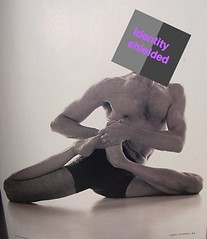

 (left-hand photo below), which often is fine. The knee hinge closes, like closing a door, normal bending. Then the pose continues by pulling the feet outside of the upper legs, like pulling upward on the door hinge. If you do not inwardly rotate both upper legs at the hip fully, your knee twists at the hinge, overstretching the medial (inside- facing the other knee) ligament, pinching the lateral (outer) meniscus and soft tissue. Lying back, as in the right-hand photo adds prying of the joint to the rotation damage (often people overarch the lower spine too instead of stretch the muscles, an additonal problem). In "W" sitting, both feet face outward. Not a problem for the knee unless the hips do not fully rotate (whether relentless W sitting is eventually is too much at the hip is a separate question). Runner's hurdler stretch is the same issue, one leg at a time.
 Warrior poses 1 and 2 are like a lunge. Check your front knee:
 Mighty Chair pose - watch for, and change overly-stylized artificial position, not valuable for any functional motion (photo right and lower drawing left).
 Check that you don't crane the neck while raising arms, impinging rotator cuff and shearing neck vertebrae and greatly overarch (hyperlordose) the lower spine, see Prevent Back Surgery.
 The beginning of one of the pigeon poses is pictured at right. The person pictured is sitting to the side, instead of keeping the back knee and leg rotated to face straight downward. Sitting to the side greatly reduces the stretch, especially to the rear hip's front muscles that need the stretch, but usually no big problem to the knee. When the pose continues to lift the back foot for King Pigeon, if you lift the foot up without facing the knee downward, you twist the knee joint. By turning the whole leg downward, you get a better anterior hip stretch, and when you lift the foot, the knee can bend like a hinge, not twist.


![Reblog this post [with Zemanta]](http://img.zemanta.com/reblog_e.png?x-id=82dc1ac0-ff92-4292-9229-6b4fa571ae21)