Reader Success With Functional Fitness Training - Stronger Ankles, Better Balance
Thursday, October 01, 2009
Jolie Bookspan, M.Ed, PhD, FAWM
Here is a good start to October. I had invited readers to send in names for my group Functional Fitness Training program (tentatively named FFT) and success stories using it. Reader Paul J sent in both. He wrote:
"I don't think I can come up with a better name than FFT.
"Some ideas….let's see,
"Simple Training Big Benefits. (The toe balance training is great; I suppose a success story is in order.) Bookspan's Basic Training. Bookspan's Body Basics. Basic Fitness Training Basic Functional Fitness Jolie's Joint Jewels (That has a nice ring to it, it might be good for something like a list.) Functional Physical Training.
"Well, what do you think, any keepers?"
Readers - votes? The "Basic Functional Fitness" name has the advantage (as does "Bookspan Functional Fitness") of the initials BFF, young person lingo for "Best Friend Forever."
Paul J. continued with his success story:
"I have been doing your toe balance training and have noticed some interesting things. Before I learned your toe balance training I would usually stand on one foot to put my sock on and had decent balance from martial arts, but felt my ankles were weak. I even bought a BOSU and it may have helped, but you have to be on it, to get a benefit from it. I remember the first time I tried your technique and how quickly my right foot tried to roll out.
"Thanks to your simple do-anywhere training my ankles are stronger and my balance is much better. The other day stepping out of the tub I had such an odd sense of stability when standing on just my right foot, I looked at my ankle. My general balance has improved too. I have a folding bike with 20” wheels and for the past 3 years hands free was a very bad idea, just the other day it was quite easy. All though to some this may still be a bad idea, it was done in a nice low traffic neighborhood.
"May your favorite physiologist have a fun Friday afternoon. : ) "
--- Read and contribute your own success stories of these methods. Before asking questions, see if your answers are already here - click labels under posts, links in posts, archives at right, and the Fitness Fixer Index. For answers to personal medical questions - Replies to Medical Questions. Subscribe to The Fitness Fixer, free. Click "updates via e-mail"(under trumpet) upper right. See Dr. Bookspan's Books, take a Class, get certifiedDrBookspan.com/Academy.
Fast Fitness - Better Legs and Pain Relief Comes From You Not The Exercise Ball
Friday, April 03, 2009
Jolie Bookspan, M.Ed, PhD, FAWM
Here is Friday Fast Fitness - Be healthful when you do health activities. What a concept.
How fit is it to use fitness equipment in unhealthy ways?
When you pick up and put down an exercise ball, or any exercise equipment, how do you bend? Unhealthfully? During an activity you use to improve your health?
Robert Davis sent in this change of bad bending to good bending . Good bending shifts weight and leverage off lumbar discs and onto leg, hip, and back muscles.
Robert Davis wrote. "I had to use my cell phone on timer so the pictures are not the greatest quality."
Here is the ouchy
Here is the squat
Robert Davis was a weight lifter with a painful back injury from conventional lifting. He fixed his back pain with Fitness Fixer, intelligently applying principles of healthful movement for everything during exercise and also daily life. He wrote:
"I took a picture of what was causing "ouchy" because it is so normal in America *for adults!*.. (upper photo of forward bending). Then ouchy started to go away the more I did, 'ah much better' (squatting)... Pretty soon ouchy was gone from the bad forward bending.
"I am now doing a complete head to toe revision... Point was that my back stopped hurting, and as you said, heals when I let it, with better movement.
"I am glad there is someone out there like you who tells you how it is. It gives encouragement and hope. I have seen people my age already with a few surgeries (and they are in the 20s to 30s!). They were from injuries, and sadly they never had a chance to find that they didn't need it.
"I was encouraged by others' stories and with your statement, "don't let them scare you" because I was a bit scared. I have never been injured before with that much pain. But, I was more then willing to try this because I did not want limitation as I had seen in my friends who had surgery. Some multiple times. "
Mr. Davis has been sending in success stories one after then next. Here are some of his Inspiring Functional Fitness:
--- Read and contribute your own success stories of these methods. Before asking questions, see if your answers are already here - click labels under posts, links in posts, archives at right, and the Fitness Fixer Index. Subscribe to The Fitness Fixer, free. Click "updates via e-mail"(under trumpet) upper right. For answers to personal medical questions - Replies to Medical Questions. Limited Class spaces for personal evaluation. Top students may apply to certify throughDrBookspan.com/Academy.See Dr. Bookspan's Books. ---
Fast Friday - Oblique Core Strength and Balance on the Ball
Friday, March 20, 2009
Jolie Bookspan, M.Ed, PhD, FAWM
Here is Friday Fast Fitness - develop strong side abdominal and back muscles, and train balance at the same time:
Put both hands on the floor and step one foot up onto an exercise ball of any size
Step the other foot up to the ball and turn sideways. Hold straight (upper photo). Hold and feel all abdominal and back muscles working strongly to hold yourself straight.
Work up to raising one arm.
Don't let body sag (lower photo). The idea is to train your muscles to be able to hold straight against the resistance of your own body weight during daily life when walking and everything you do. If your muscles don't have the strength or endurance to hold you, then you will sag onto your joints.
At first, you may need help to steady the ball. Practice until you can steady it with your own muscles, balance, and stability.
Instead of sitting on an exercise ball, remember that you might already sit much of the day. Get up and use an exercise ball for more functional, active, and healthful things.
Send in your photos of your fun successes using the ball in ways that train function. Exercise ball success story already in progress from Robert Davis. See his first story - Fixed Injuries, Got Strong, With Functional Exercise.
---
Read success stories of these methods and send your own. Questions come in by the hundreds. I make posts from selected ones. See if your answers are already here by clicking labels under posts, links in posts, and archives at right.
Subscribe to The Fitness Fixer, free. Click "updates via e-mail"(under trumpet) upper right.
Fast Fitness - How Abdominal Muscles Prevent Hyperlordosis When Carrying
Friday, January 09, 2009
Jolie Bookspan, M.Ed, PhD, FAWM
Here is Friday Fast Fitness - How to use your abdominal muscles to maintain neutral spine when carrying babies, and other things held and carried.
When you hold loads in front, notice if you lean your upper body backward - right-hand photo marked with red X. Leaning backward from the waist increases lumbar lordosis (hyperlordosis) which pinches the lower spine, causing aching after long standing.
Instead, stand upright - middle and left photo. The muscles that pull your spine forward to straight position against the load are your abdominal muscles. Upper spine angle will be a little more upright than pictured (center).
It is a myth that you must lean back to offset a carried load. You get a free abdominal muscle workout and increase abdominal muscles endurance by using them (not tightening) to change from painful to healthful standing position. Breathe normally.
David from Belgium is pictured at left. David has made many contributions to Fitness Fixer through photos, movies, success stories fixing his own pain and of his yoga students, translated many of my articles into Dutch, and has developed a healthier yoga style which he premiered at a world yoga congress last year
He did all this during the time he and wife (pictured center and right above) were expecting their first baby, arriving early last February. Thank you David and family from all of us.
Questions come in by the hundreds. I make posts from selected ones. See if your answers are already here by clicking links and archives. Read success stories of these methods and send your own.
Have The Fitness Fixer e-mailed to you, free. Click "updates via e-mail" - Health Expert Updates (trumpet icon) upper right column.
"Hello, I'm writing as someone who has incurred a training-related lower back injury and who has great interest in your words on hyperlordosis. I am hoping that you might shed some insight on how to achieve a neutral spine while doing "kettlebell swings." This is the exercise that has caused me back pain, and I would love to return to working out with kettlebells, but am not sure how to do so without creating too much lordosis. Any ideas? I appreciate any assistance you can provide and thank you for your contributions! Take care, Dan L"
Throughout history, people have lifted and swung weights of all kinds of shapes. Kettle bells (also called kettle balls and many other names) are usually ball-shaped weights with a handle. A variety of sizes is shown in the photo, above, along with a medicine ball for comparison.
Kettle bells were long used in various martial arts and cultural festivals and contests before being rediscovered for modern weight lifting. In general, you lift, swing, and move them to do various weight lifting exercises. Kettle bells are weights. Benefits of kettlebells are the same as lifting and swinging other kinds of weights.
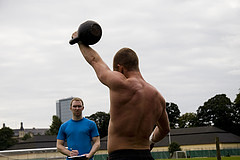
The photo above shows injurious lower spine posture of the person lifting or swinging overhead, called overarching, swayback or hyperlordosis. His upper body tilts backward relative to the lower spine. There is too much inward curve, pinching and compressing the lower spine. You can even see this pinched fold in his lower back. This poor posture is a common cause of lower back pain. People who chronically over-arch this way often feel they need to bend over forward to make the pain stop. However, using neutral spine and not allowing the slouch while lifting overhead would stop the cause in the first place - right photo below.
Recent kettlebell devotees have made a small set of lifts, and limit swings to mostly vertical swings up and down between the legs. However, a wider range of movement and more function can be trained. Great benefits are possible using weights with handles for functional core stability training, as below.
The photos above, of injurious overarched spine position (left) and healthy neutral (right) while swinging a heavy medicine ball overhead, are from the book Healthy Martial Arts. My black belt student Christopher demonstrates. This is a similar motion as swinging kettle bells overhead by the handle.
In the left photo, Christopher demonstrates the hyperlordosis posture that compresses the lower spine and is a major cause of lower back pain. He allows the hip (pelvis) to tilt forward in front and out in back, and his upper body tilts backward relative to the lower spine. In the right photo, he reduces the overarching to neutral spine. The belt line changes from tipped downward in front to level.
Keep neutral spine when lifting and swinging kettlebells and any weight overhead (right photo). Prevent the slouch of leaning your upper body backward and tilting the pelvis (left photo). Leaning backward and allowing the hip to tilt are often mistakenly done to "balance the weight" and make the lift easier. Leaning the upper body back and tilting the pelvis are not necessary to balance a load - your own muscles can hold the load, and in fact, that is the point of lifting the weights.
Overarching increases the small normal small inward curve (normal small lordosis) to a large curve (hyperlordosis). Hyperlordosis increases compression on the joints (facets) and soft tissue of the lower spine. The same overarching is the hidden cause of back pain in women who lean back and/or tilt the hip trying to offset the load of a pregnancy - Back Pain in Pregnancy - and Why Men Can Get It. Leaning backward and overarching are not helpful adaptations as sometime thought, are not unavoidable, and are not limited to pregnant women. Overarching (hyperlordosis) is a common bad posture, and an often missed source of back pain. It can be easily prevented by using your muscles to hold neutral spine. The post Prevent Back Surgery shows photos of hyperlordosis compared to neutral spine during many activities.
Bending over forward to swing kettlebells between the legs is another exercise where injury and back pain frequently occur. Good squatting technique reduces the problem. Often weight lifters spend much time learning and debating good squat posture, then bend over (injurious bad bending) to pick up and put down their kettlebells.
Neutral spine while exercising with kettle bells is the same as neutral spine during anything else - just hold your spine position. Neutral spine is not done by tightening or clenching any muscles. It is done by moving your hip and lower spine the same way you move your arm to scratch your nose - without tightening, just moving it to where you want it. Holding neutral spine is the same as not slouching your shoulders or not letting your mouth hang open - a voluntary use of your own muscles - built-in exercise.
Keep breathing, Have fun. You can swing weights of any kind in any variety of ways, to be stronger and healthier, without injury.
Learn neutral spine swinging kettlebells, babies, and all other fun weightlifting:
Fast Fitness - Stronger Arms and Chest, and Core, Hip, and Leg Stability With A Friend
Friday, March 14, 2008
Jolie Bookspan, M.Ed, PhD, FAWM
Here is Friday Fast Fitness - strengthen inner legs, thighs, arms, and core, while practicing neutral spine with a friend. More exercise than putting hands up on a bench or exercise ball.
My students Johanna (1) and Diana (2) demonstrate the beginning of this move. Description of how to progress follows the photos:
Partner 1 lies face up with bent knees
Partner 2 does pushups on Partner 1's knees while holding neutral spine, not letting the lower back sag and arch downward. Partner 1 gets entry-level exercise hip and core exercise by holding legs stable and does not let knees wobble. Higher-level exercise is described below the photos.
To increase core and hip stabilization training for both partners, Partner 1 tilts knees slightly to each side while Partner 2 continues pushups. Try both moving continuously side to side, and holding legs stable at an angle. Do not twist your spine.
Fast Fitness - Strength, Abs, Balance, and Ankle and Leg Stabilization
Friday, November 09, 2007
Jolie Bookspan, M.Ed, PhD, FAWM
Here is Friday Fast Fitness - quickly increase functional stabilization of the knee, leg, and ankle while increasing overall strength and balance.
Anyone can lift weights, but can you do it balancing on a basketball? Get started by standing on one foot:
Do your regular lifts, curls, presses while standing on one foot (and then the other). Breathe.
Notice the leg you stand on. Don't let the arch of your foot flatten toward the floor, or knee roll inward toward the other leg. Hold knee, ankle, arch inline, using your muscles. See Arch Support Is Not From Shoes.
It reduces exercise to sit, even on a fitness ball. It is more exercise, more functional, and better balance training to stand on one foot than to sit. You sit all day already.
Be safe, be excited about having fun doing functional movement, be happy.
The week before I left to teach at the Wilderness conference, I taught my University yoga class entirely on an exercise ball. I will post about functional movement on a ball in weeks to come.
We don't use three of the most ineffective things you can do on a ball - crunches, sitting on the ball (for almost anything), and arching the lower back over the ball. These seem to be three of the more common things done on the ball in fitness classes, but they are not fit or effective.
Another myth is that an exercise ball will magically make you sit straight. You can sit with as faulty positioning as on any other surface.
Most of my students brought in an owned or borrowed exercise ball. I brought in three more for students without access. Some of the students pin-balled cheerfully through the narrow doorway with a large inflated exercise ball. One came in on the subway holding hers. I managed a comic, calorie-burning commute with three on a bicycle. A few students brought theirs uninflated. Wow, such an idea.
They asked me if I had a pump.
I told them, "Yes, your lungs, blow it up."
They sat politely waiting for the other students who brought a pump to finish with theirs.
I chided them that people talk all about yoga and breathing but here was opportunity in the tangible. They sat politely waiting for the pump. I demonstrated - "fffooooooooou."
I told them that when I was small, I was transfixed when my father, a Russian ice swimmer, blew up a beach ball in one breath. I decided then and there that I wanted to do that. I experimented with bags. I'd inflate to all my capacity and compare the bag to my little chest. I later practiced this in my swimming career until I was measured by scientists who came one day to test our whole team. My lung volume (not counting residual that you cannot breathe out) came in close to 6 liters. They called me a sports car. I didn't know what that was and hoped they were not flunking me. Who knows how much was from my 35 to 40 mile a week swimming training, or inherited, or just lung size relative to height. Still, a "big engine" can be trained and added to the mix. Click the label "breathing" under this post for entries about training breathing and exercise capacity.
My students took a chance on believing me that breathing and yoga and health had something to do with real life, and took a big breath to the ball. Bigger, bigger, full. Then quick hands to cap it off. They laughed. Laughing is good for breathing too. Then we started class.
Take a nice full breath in right now. Let your lower abdomen come outward. Exhale normally.
Breathe when you cook, clean, and do daily life. Don't hold your breath or gasp.
Blow up balloons, pool floats, air cushions, enormous inflatable beach toys. Don't overbreathe and get dizzy.
Exercise until you have to breathe a lot. Don't let yourself get so out of shape that it ever becomes unhealthy to try fun exercise.
--- I make posts from fun mail and success stories. Before asking questions, see if your answers are already here - click labels under posts, links in posts, archives at right, and the Fitness Fixer Index. Why not try fun stuff, then contribute! Read success stories of these methods and send your own. Subscribe to The Fitness Fixer, free. Click "updates via e-mail"(under trumpet) upper right. See Dr. Bookspan's Books, take a Class, get certified - DrBookspan.com/Academy. ---
Photo - from the world's strongest lungs competition
Healthline staff helpfully sent in photos of sitting at work on an exercise ball. Both photos show obvious slouching and forward rounding.
A ball does not make you sit upright or prevent unhealthful, uncomfortable sitting position. You can sit upright or not. It is not the ball, but you, that determines what you do with your own body.
A ball that is too high will even prevent you from sitting close enough to the desk, so that you have to lean over forward to reach the surface.
Use common sense and your own muscles for simple, comfortable, healthful habits.
Photos courtesy of Healthine.com staff. Please do not try these bad postures at home. Healthline staff are trained professionals.
---
Read success stories of these methods and send your own. Before asking questions, see if your answers are already here by clicking labels under posts, links in posts, archives at right, and The Fitness Fixer Index. Subscribe to The Fitness Fixer, free. Click "updates via e-mail"(under trumpet) upper right. For personal medical questions - Replies to Medical Questions. Limited Class spaces for personal feedback. Top students may apply for certification throughDrBookspan.com/Academy. Learn more in Dr. Bookspan's Books.
"Thanks to your simple do-anywhere training my ankles are stronger and my balance is much better. The other day stepping out of the tub I had such an odd sense of stability when standing on just my right foot, I looked at my ankle. My general balance has improved too. I have a folding bike with 20” wheels and for the past 3 years hands free was a very bad idea, just the other day it was quite easy. All though to some this may still be a bad idea, it was done in a nice low traffic neighborhood.
![Reblog this post [with Zemanta]](http://img.zemanta.com/reblog_e.png?x-id=5c22d222-7e1a-4d90-a26c-4d7a62aa50fd)