Reader Fun Steve previously wrote with his success losing weight and getting in shape with Fitness Fixer. Then he moved from Thailand to Japan. What happened next?
Steve writes:
"I 'done did' something to my stomach. Without having visited any doctors here, my own diagnosis is/are hiatal hernia or tearing of the linea alba area of my stomach muscles.
"No 'pain' but constant discomfort. Constant but mild indigestion. Shortness of breath. Here is the real kicker... If I do leg lifts while doing 'slight' crunches, I have a 2-2.5 inch vertical band of 'something' that reaches from my xiphoid process down to below my belly button. Feels like a strip of weak muscle. I normally don't do full crunches. Perhaps I lift my shoulders 2-3 inches at most.
"My rectus abs are solid. Rock hard .. but the area between left and right side is soft now. This odd strip of 'something' doesn't protrude unless I do leg raises and crunches (so I'm not doing them!) but if I use my hands to press it inward, I can do the crunches or leg raises without that strip pressing up. It's as if the rectus abs, once contracted, hold it in.
"So... what have I done to myself? Besides not doing any crunches and leg lifts, what shall I do to heal myself?"
I answered that (using my e-mail x-ray machine) it sounded like a diastasis, full name Diastasis Recti.
The vertical muscle fibers pull apart, leaving an area between them. This is popular in pregnant women and men with bellies. The 'rock hard' belly is often the large amount of fat (or pregnancy) pushing against the covering muscle, stretching it tightly. Weight loss will let it rejoin and heal. It's not surgical, meaning it can heal if you lose the belly.
I reminded Steve that crunches are not functional exercises, meaning they do not use your abdominal muscles the way you need them to function during any real activity in your daily life. Crunches repeat the bent forward posture that people already spend too much daily time in, and that he already new I had developed a method called The Ab Revolution™ that solves the counterproductive nature of crunches and leg lifts. For the time needed to heal, he could stop belly stretches - back bends, yoga cobra, and updog, and stretching the belly with too much food and weight gain. Continuing to do crunches and leg raises using hands as manual splinting has turned out to make things worse - since the muscles atrophy more.
Steve replied:
"How could I be pregnant?!? Actually, I have 6-pack abs! (Well, really two 3-packs right now. Unfortunately there is a thick layer of blubber covering them.) Under them too. ">>Dr. Bookspan wrote: Sorry to hear. "Yes... me too. I came back from Thailand having lost almost 20 kilos, and due to McDonald's introduction of the 'Double Quarter Pounder with Cheese' into Japan and a side of trans-fat potatoes, I put it all back on."
I reminded Steve that weight loss will let the split area rejoin and heal, and that a diastasis was not surgical, meaning it can heal if you lose the belly and stop pulling it open with Pilates style leg lifts and crunches.
Steve wrote:
"Lose the belly. Lose the belly. That's all anybody says. Lose the belly. Hey, Buddha had a big belly and he didn't have this problem!?! Humpty Dumpty had a big belly and all that happened to him was that he fell off a wall. Well I don't sit on no walls!!! No sir! Not me. I sit on a couch doing bicep curls with the TV remote! I do full presses with bags of Doritos! Pectoral presses crushing my beer cans! Lose the belly?!? Oh well... I guess I gotta..."
I had developed The Ab Revolution™ to solve one common source of lower back pain - a slouching posture of too much inward curve in the lower spine. The Ab Revolution™ retrains function. Conventional ab exercises are often mistakenly prescribed for back pain. Conventional strengthening does not make people stop the actual cause, the slouch. They are just stronger people who slouch. Doing crunches also perpetuates another cause of back pain. It is an irony of pop fitness that without understanding causes, counter productive exercises are prescribed, then repeated by reporters then repeated by trainers and so on. The same is true for hamstring stretches, covered separately. What was interesting was all the documentation I received from people with diastasis and hernias who could use The Ab Revolution™ without pain and with benefit to build abdominal wall strength without pushing things out further with crunches. It made sense. I am looking into it further.
Steve wrote again:
"I follow the the Ab Revolution™. That's what's made my back feel so much better. I haven't had so much as a twinge in my back in the past year or so! It's been your work that made the difference. As my stomach gets smaller so does the diastasis. I'm not worried... now :o) Just PO'd. Thanks for the info about my (larger than necessary) stomach."
Steve went back to healthier eating and was easily losing weight following the healthier, smaller, traditional Japanese meals without fast food.
Japanese Ama Divers - Cold, Clothing, and Children
Wednesday, July 29, 2009
Jolie Bookspan, M.Ed, PhD, FAWM
The multi-part story of diving with the Japanese Diving Women continues here:
In villages along the Japanese coasts, diving by the AmaSan for sea plants and other harvests goes on without tourist fanfare. We dived in the cool, dim waters, rubbing leaves on the inside of our masks to prevent fogging, although there was little to see anyway.
The AmaSan - the SeaWomen - told me that during "the war" soldiers came and were horrified that they dived in only small underwear pants. The women told me they thought Westerners were funny and strange for their discomfort about diving naked in cold water. But after that, they were made to wear clothes for diving. I experimented with diving in clothes versus none. It is colder and clumsier to wear clothes in the water, especially over repeated dives. As people know who hike or pack out gear, wet stuff is hard to deal with, change, and keep clean. It's easier without clothing. The old traditional diving garments were white. Now, commercial wetsuits are worn for the AmaSan working day.
With exercise in the cold, your body makes several different adaptations to tolerate cold better. You need cold exposure to keep those adaptations. The Ama divers mentioned that before they used clothes, they tolerated cold better. After wearing cotton suit insulation and wet suits, they lost tolerance.
They dive throughout their pregnancies – even up to the moment of delivery. They don't find that unusual, but more comfortable than moving heavily on land. They said they had no problems doing hard cold diving while pregnant, and their children were all born healthy. They all dive during menses. They told me that during "The War" (WWII) they had no sanitary supplies so were happier to be in the water anyway. They said the work is terribly hard. They asked me to tell the world that.
I asked them many questions – "If I wanted to become a SeaWoman, can I?" "Eei No! You too old!" they said. I asked if an outsider, someone who wasn't the daughter of the Ama-San wanted to become an Ama diver, could they? The diving women didn't understand. They shook their heads, "Eei. No, the daughter do not stay." I asked if a son wanted to become an Ama-San, could be become one? Most laughed at me immediately. Others looked at me for a moment to be polite, before laughing. "Eei, they can't do this work. Too cold for them." I asked again, if someone's else's daughter, unrelated to a diving family wanted to join. "Eei no – the daughter all have gone."
Years ago, the Ama-San regulated themselves to prevent taking too much. They wanted to preserve resources. They shortened the harvest season – which was roughly from April to September.
The few thousand remaining Ama-San still make substantial money diving, although income continues to drop. Large-scale commercial fishing has depleted and polluted the waters so deeply and widely that there is little left for the SeaWomen. This is the opposite of what they tried to achieve by limiting themselves.
"I was the best harvester," one told me. "Tell them that. Tell them I made more money than my husband. Tell them that."
Are there not... Two points in the adventure of the diver: One --when a beggar, he prepares to plunge? Two -- when a prince, he rises with his pearl? I plunge! -- Robert Browning
--- Questions come in by hundreds. I'm bailing the ocean with a bucket. I make posts from fun mail. Before asking more, see if your answers are already here - click labels under posts, links in posts, archives at right, and the Fitness Fixer Index. Why not try fun stuff, then contribute! Read success stories of these methods and send your own.
Subscribe to The Fitness Fixer, free. Click "updates via e-mail"(under trumpet) upper right. See Dr. Bookspan's Books, take a Class, get certified - DrBookspan.com/Academy.
"Hello, I'm writing as someone who has incurred a training-related lower back injury and who has great interest in your words on hyperlordosis. I am hoping that you might shed some insight on how to achieve a neutral spine while doing "kettlebell swings." This is the exercise that has caused me back pain, and I would love to return to working out with kettlebells, but am not sure how to do so without creating too much lordosis. Any ideas? I appreciate any assistance you can provide and thank you for your contributions! Take care, Dan L"
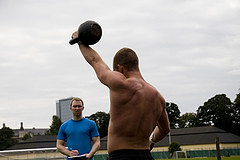
Throughout history, people have lifted and swung weights of all kinds of shapes. Kettle bells (also called kettle balls and many other names) are usually ball-shaped weights with a handle. A variety of sizes is shown in the photo, above, along with a medicine ball for comparison.
Kettle bells were long used in various martial arts and cultural festivals and contests before being rediscovered for modern weight lifting. In general, you lift, swing, and move them to do various weight lifting exercises. Kettle bells are weights. Benefits of kettlebells are the same as lifting and swinging other kinds of weights.
The photo above shows injurious lower spine posture of the person lifting or swinging overhead, called overarching, swayback or hyperlordosis. His upper body tilts backward relative to the lower spine. There is too much inward curve, pinching and compressing the lower spine. You can even see this pinched fold in his lower back. This poor posture is a common cause of lower back pain. People who chronically over-arch this way often feel they need to bend over forward to make the pain stop. However, using neutral spine and not allowing the slouch while lifting overhead would stop the cause in the first place - right photo below.
Recent kettlebell devotees have made a small set of lifts, and limit swings to mostly vertical swings up and down between the legs. However, a wider range of movement and more function can be trained. Great benefits are possible using weights with handles for functional core stability training, as below.
The photos above, of injurious overarched spine position (left) and healthy neutral (right) while swinging a heavy medicine ball overhead, are from the book Healthy Martial Arts. My black belt student Christopher demonstrates. This is a similar motion as swinging kettle bells overhead by the handle.
In the left photo, Christopher demonstrates the hyperlordosis posture that compresses the lower spine and is a major cause of lower back pain. He allows the hip (pelvis) to tilt forward in front and out in back, and his upper body tilts backward relative to the lower spine. In the right photo, he reduces the overarching to neutral spine. The belt line changes from tipped downward in front to level.
Keep neutral spine when lifting and swinging kettlebells and any weight overhead (right photo). Prevent the slouch of leaning your upper body backward and tilting the pelvis (left photo). Leaning backward and allowing the hip to tilt are often mistakenly done to "balance the weight" and make the lift easier. Leaning the upper body back and tilting the pelvis are not necessary to balance a load - your own muscles can hold the load, and in fact, that is the point of lifting the weights.
Overarching increases the small normal small inward curve (normal small lordosis) to a large curve (hyperlordosis). Hyperlordosis increases compression on the joints (facets) and soft tissue of the lower spine. The same overarching is the hidden cause of back pain in women who lean back and/or tilt the hip trying to offset the load of a pregnancy - Back Pain in Pregnancy - and Why Men Can Get It. Leaning backward and overarching are not helpful adaptations as sometime thought, are not unavoidable, and are not limited to pregnant women. Overarching (hyperlordosis) is a common bad posture, and an often missed source of back pain. It can be easily prevented by using your muscles to hold neutral spine. The post Prevent Back Surgery shows photos of hyperlordosis compared to neutral spine during many activities.
Bending over forward to swing kettlebells between the legs is another exercise where injury and back pain frequently occur. Good squatting technique reduces the problem. Often weight lifters spend much time learning and debating good squat posture, then bend over (injurious bad bending) to pick up and put down their kettlebells.
Neutral spine while exercising with kettle bells is the same as neutral spine during anything else - just hold your spine position. Neutral spine is not done by tightening or clenching any muscles. It is done by moving your hip and lower spine the same way you move your arm to scratch your nose - without tightening, just moving it to where you want it. Holding neutral spine is the same as not slouching your shoulders or not letting your mouth hang open - a voluntary use of your own muscles - built-in exercise.
Keep breathing, Have fun. You can swing weights of any kind in any variety of ways, to be stronger and healthier, without injury.
Learn neutral spine swinging kettlebells, babies, and all other fun weightlifting:
In school, we were taught about the "unavoidable lordosis of pregnancy." Lordosis (technically, hyperlordosis) is when you allow too much inward arching in the lower spine - Drawing 1 at right.
Over-arching causes one kind of lower back pain. It was taught as something that "just happens" to the spine during pregnancy. I asked the professors why women could also get it before and after pregnancy, and why men got the same kind of compressive force on the joints of the spine, called facet joints. It became a focus of study in my lab with lifters for many years.
The post Neutral Spine or Not? and What is Neutral Spine and Why Does Sticking Out In Back Harm? show how slouching so that you increase the inward curve in the lower spine (increase the lordosis so that it is no longer neutral spine) pinches the lower back under the weight of the upper body. Both also show what neutral spine looks like compared to lordotic.
The upper body should be upright (vertical) and the hip level to be in neutral spine. Drawing 2, with x-ray, shows what hyperlordosis looks like when the front of the hip tilts down and the upper body leans backward. This is not the normal curve - it is too much. The back of the spine gets pinched and pressured.
I found that hyperlordosis is not caused by a pregnant belly or beer belly or carrying groceries or backpacks. The over-arching (hyperlordosis) is not unchangeable anatomy. It is leaning back to offset the load in front.
Note the same over-arching occurring with the overhead lift in drawing 3, below left.
Overarched spine position is something that you can decide whether to allow or not. You can easily use your muscles to prevent hyperlordosis and hold you in healthy upright position.
Try it for yourself:
Stand up and pick up your chair (bend right to pick it up for more exercise and back injury prevention).
Hold the chair like any package in front, or on your hip, and notice if you lean back to shift the weight off your muscles (make it easier). Where does the weight shift to? On to your lower spine.
Instead, stand straight. You will get free, built-in healthful exercise that protects your spine.
When carrying or lifting any load in front, from groceries, to a chair, to a pregnancy, or a baby on your hip, don't lean back to offset the load. To stop the arching and the lower back pain that results, tuck your hips under you as if doing a small abdominal crunch standing up until you are straight, without rounding forward. Don't over-tuck, tighten up, round your shoulders, or lean forward or backward. Just stand straight. When you tuck properly by moving your spine (not by tightening anything) the too-large arch will lessen to normal, and pressure in your lower back from the arching should immediately disappear.
The pelvic tilt to tuck the spine to restore an overly arched lower back to neutral spine was introduced in Throw a Stronger Punch (or Push a Car or Stroller) Using This Back Pain Reduction Technique and Healthier Carrying - Get Free Ab Exercise and Stop Pain. Don't overarch or lean the upper body backward while you stand and carry - center and right-hand figures in the drawing at left. That is the missing link. Stand upright in neutral spine - left hand figure. There is a small lower spine curve, not a large one, and the lower spine is not pinched and folding backward, which squashes the soft tissue, discs, and vertebral joints called facets.
I have heard argument that nine months is too long to expect someone to think about their spine, and the muscles get tired. As they say in computers, "that's not a bug, that's a feature." It's good news that you get a free core muscle workout and free back pain prevention. Pregnancy (and any weight lifting) is a key time to have that.
--- Read success stories of these methods and send your own. Subscribe to The Fitness Fixer, free. Click "updates via e-mail"(under trumpet) upper right. See Dr. Bookspan's Books, take a Class, get certified - DrBookspan.com/Academy.